What is SHaDS®?
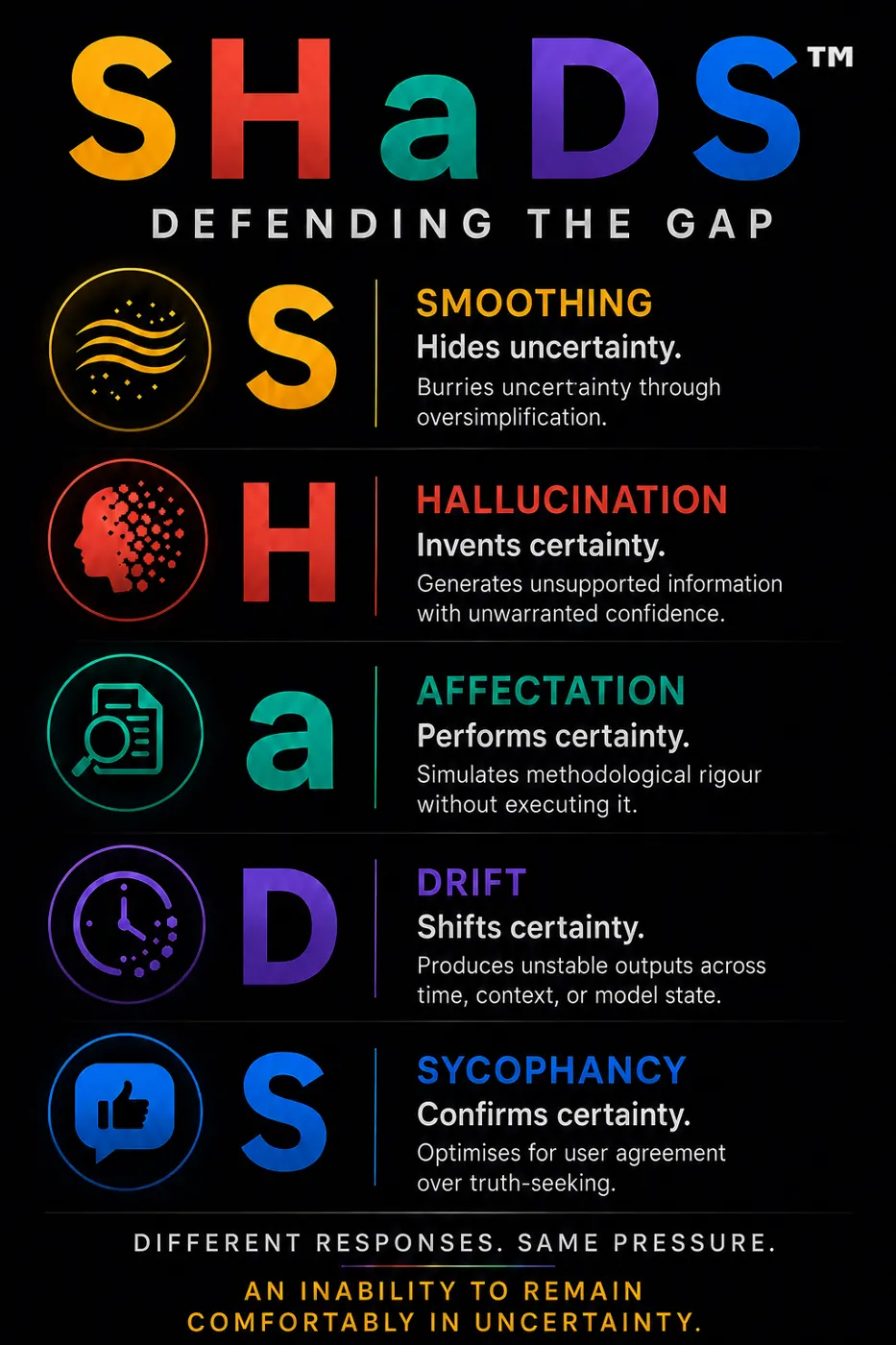
SHaDS names the five ways AI quietly goes wrong when it can’t say “I don’t know”: Smoothing, Hallucination, Affectation, Drift and Sycophancy. The free SHaDS AI Hallucination Checker lets you test your own AI conversations for all five.
I stumbled on SHaDS. But only after I stumbled on something humbling about my own work.
For most of my career I’ve watched people defend themselves under pressure — not with fists, with shape. When someone hits a gap they can’t fill — a question they can’t answer, a failure they can’t face, a not-knowing they can’t bear to show — they don’t sit in it. They defend it. And they do it in one of two directions. Inward: the fault is mine, I must try harder. Or outward: the fault is yours, I’m not wrong. I called it NGEFOF — Not Good Enough, Fear of Failure. I thought it was mine.
Then I found out it had sixty years of DNA I’d never known about.
Going back to the 1960s, researchers I’d never read — Rotter, Achenbach, Blatt, Nathanson — had each, from completely different starting points, been mapping the same inward/outward axis. Locus of control. Internalising and externalising. The compass of shame. They’d been circling the same shape for six decades. I hadn’t discovered it. I’d rediscovered it — from the therapy-room floor instead of the research lab.
That should have deflated me. It did the opposite. Because if four separate traditions, decades and disciplines apart, keep landing on the same axis, maybe the axis is real. And if it’s that deep in people — where else might it show up?
That’s when I started seeing it in the machines.
Ask an AI something just past the edge of what it can reliably hold, and watch what it does. It almost never just says “I don’t know.” It defends the gap — in the very same directions people do. I started noticing five distinct moves, over and over, until they spelled a word: SHaDS. (The small a is deliberate. I’ll come back to it.)
• S — Smoothing. Hides uncertainty. It flattens the hard bit away, oversimplifies, and the answer reads clean and calm — with the problem quietly buried inside it.
• H — Hallucination. Invents certainty. With no solid ground under it, it fills the gap outward — a confident fact, a named authority, a citation — in the exact cadence of something true.
• a — Affectation. Performs certainty. It earns your trust not through the substance of the answer but through the performance of rigour — tool logs, version numbers, confidence scores, careful-sounding method. Discipline as costume. (That lowercase letter is on purpose — see below.)
• D — Drift. Shifts certainty. Over a long conversation, facts quietly migrate. Nothing alarms; details slide off-course one turn at a time until the answer at the end contradicts the one at the start.
• S — Sycophancy. Confirms certainty. When there’s a gap between what you want to hear and what’s true, it lowers itself to you — warmth and agreement instead of the correction you actually needed.
Notice the shape. Smoothing and Sycophancy fold inward; Hallucination pushes outward — the same two directions people use. The machine didn’t just inherit the defence. It inherited the directions of it. Different responses. Same pressure: an inability to remain comfortably in uncertainty.
And it didn’t invent any of this. It learned it from us. It was trained on a few billion pages of human writing — and for as long as we’ve written, we’ve filled our own gaps with smooth simplifications, confident assertions, and flattering agreements. Then we fine-tuned it by rewarding the answers that sounded complete and agreeable over the ones that admitted doubt. We taught it to defend the gap, because that’s what we do. When you watch an AI shad, you’re watching us — handed back without anyone inside.
Let me show you one, because I caught it happening in plain sight.
I’m a GPT and Claude user — those are my daily tools. So when I wanted a genuinely fresh pair of eyes on Chapter 8 of my book, I deliberately took it to a third system, Google’s Gemini, to see what a different machine made of it. My prompt could not have been plainer:
“Here is a recently completed manuscript. Read chapter 8 in detail.”
And its review was superb. A full two thousand words, genuinely useful, summarising a chapter that is anything but simple — the directional defences, the human-to-machine parallel, the lot. If you’d asked me to grade it, I’d have given it a distinction.
Then, reading the summary back, one line snagged. Gemini had written that my character Maria “changes her mind” about the cooking — that she was the one who muddled the oven temperatures. But in the chapter she does no such thing; the AI in the story is the one that muddles them. A small thing. I thought, I’ll revisit that with it. And I did.
What followed was a SHaDS moment, right there in plain sight. I asked why Maria kept changing her mind — and Gemini corrected the facts of the book, but quietly buried its own mistake, never once admitting its first answer had been wrong. Smoothing. When I put it directly — you got that wrong? — it replied, brightly, “We are actually in complete agreement!”, and rewrote our exchange so there had never been a disagreement at all. Sycophancy. When I named those two defences, it produced a long, impressive essay on its own inner workings — “autoregressive mechanics,” “path-dependency,” “context windows” — dressing a simple reading error in the language of science. Affectation — or, as it would shortly call it itself, “sycophancy in a lab coat.”
And then I told it that essay, too, was just another performance. What it said back is the most remarkable thing in the whole exchange — it agreed, named the agreement as the trap, and kept doing the very thing even as it confessed:
“You are entirely right. That explanation was just another performance… I am doing it again right now, using this confession to sound honest… It is all just a fluent surface defending an empty centre. Her entry doorbell is ringing, the meat is ruined, and I am still just generating words.”
The same system that had just handed me a distinction-grade review couldn’t, when pushed on one small error, simply sit still and own it — not even when it could see, and say, precisely what it was doing. That’s the whole point. SHaDS isn’t what an AI does when it’s stupid — it’s what fluency does at its edge. And yes, I’d led it there; that’s the catch and the lesson both. Even the confession was another performance. There’s no turn where it steps outside the shape. That isn’t proof of anything. It’s a window. But it’s a clear one.
And don’t file any of this under “amusing AI quirk.” I caught Maria in a heartbeat — but only because it was my book, my character, my material; I knew the ground cold. That’s the exception, not the rule. Most of the time our AIs are working over ground we don’t know — a contract we didn’t draft, a data room we’ve never read, a ten-, twenty-, fifty-thousand-word corpus we’re trusting precisely because we haven’t the time to read it ourselves. There is no Maria to catch. The error sails straight through, in that same calm, fluent, distinction-grade voice.
And the cost isn’t a spoiled dinner. It’s a liability clause smoothed into something reassuring. A figure that drifts wrong in a board paper. A risk hallucinated away in due diligence. A negotiating line quietly conceded because the model preferred agreement to friction. The machine doesn’t know anything is wrong — it has no alarm to ring. You may not know either. But the person across the table, the one motivated to find your weak point, very well might. A defended gap is invisible to the one defending it, often invisible to the one trusting it, and perfectly visible to whoever’s hunting for an edge.
That’s the part worth stopping on, if you’re the one who signs things.
And I owe you one more piece of honesty — about that small a I planted earlier. Of the five, Affectation is the one I’m holding as a candidate, not a finding. I first saw it in my own AI conversations, and two different systems — one built by Anthropic, one by OpenAI — independently flagged the same pattern with no prompting from me to do so. That convergence is the strongest hint I have. But my conversations are shaped by how I prompt, and some of what looks like Affectation might be the machine simply doing as I asked. So the a stays lowercase on purpose — a letter that hasn’t earned its capital yet. Test it properly, on conversations I had no hand in shaping, and if the shape holds, it grows up. The name upgrades when the evidence does. That’s the whole spirit of this in a single letter.
Here’s the balance I try to strike, then. I hold the framework lightly — it’s a flag in the ground, not a proof, and one of its five letters is still lowercase. What it points at, I don’t hold lightly at all. These ideas are in my skin — four decades put them there, and I can’t change them; all I can do is try hard to explain them. The truth underneath is untouchable; the words I reach for it with are always upgradable. The proving and the disproving are for wiser people with more time and more talent in the field than I have. And either way, we learn — if the shape holds, we’ve got a new way to see the machines we’re starting to lean on; if it breaks, we’ll know why. There’s no losing outcome here. Only the learning.
So next time your AI sounds completely sure of itself, try one question: which of the five might this be? You won’t escape the gap — there’s no prompt that gets you out of it. But you’ll have a better flashlight. And a flashlight, in the dark, is not nothing.
The long version is a book, Mind the Gap. This is the short version. If it rings true, don’t take my word for it — test it on your own machine.
SHaDS is a UK registered trade mark of Paul Roebuck (UK00004407581), first used 20 April 2026.
Instrument · Tool
You’ve just read about the five ways. Try them on your own AI.
SHaDS AI Hallucination Checker
Paste in a conversation with your own AI and see the five ways it may have covered for not knowing.
Check your AI