Six days after three surgeons and an entire surgical team had spent eight hours cutting out half my tongue, a speech therapist stood at my bed and said, “Put your finger on the plug and talk.” There was a hole in my throat. I pressed my finger onto the tracheostomy plug — the breathing pipe — and the air from my lungs routed up through my voice box; lift it away, and the sound escaped.
I had one thought, and it was the whole of me: would anything come out that anyone could understand?
I shaped my mouth around the alphabet. A. B. C. My son heard me. And I understood, later, that the terror of that morning was my life’s question in a single held breath: can what happens inside a mind cross to another mind, and be heard?
This turns out to be a piece about machines.
The tangle this is trying to undo
Watch what happens whenever anyone talks about what’s going on inside these machines. They reach for a word — “it’s almost conscious” — and then, in the same breath, take it back: “not conscious, obviously; it’s not sentient; don’t quote me.” Every time. In every serious discussion, including inside Anthropic’s own paper, which uses “access consciousness” and then spends pages disowning the rest.
That reach-and-retract isn’t a stumble. It’s the sound of a missing word. We’re trying to name something real with the only term to hand — consciousness — and it’s the wrong size: too big, too loaded, and, when it comes to AI, not even allowed. So we end up mute, pointing at something we’re not permitted to name. The confusion starts right there.
The claim
For twenty years my work has rested on one conviction: the invisible can be made to show itself. Beneath what a person says and does runs a great deal they never see — and my whole craft has been making that hidden middle visible, on the basis that seeing it is the first step to changing it.
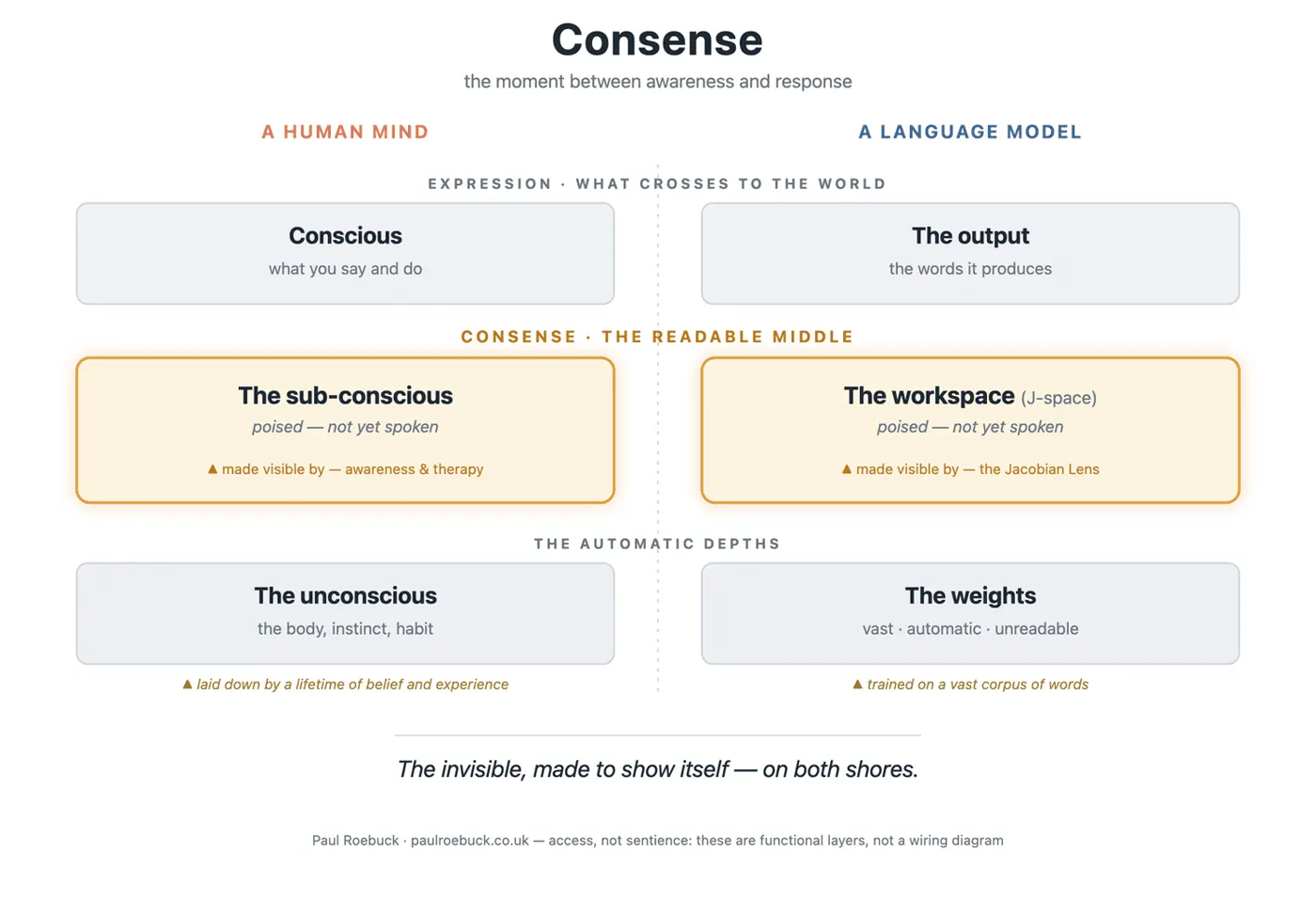
In July 2026, Anthropic showed the same thing about a machine. Their tool — the Jacobian lens (J-lens) — reads the layer of a language model that sits between its automatic processing and its spoken output: the thoughts it is poised to say but has not said. It surfaces the model’s own quiet reactions — noticing a flaw, registering a threat, something like alarm — before any of it reaches the words. For the first time, the hidden middle of a mind can be read directly.
Let me be exact about what that does and does not mean. This is access — the plain fact of a thought being reportable and usable. It is not a claim that the machine feels anything, or is aware the way you are. I use the language of mind because it is the only language we have for layers — not to smuggle in a soul.
Why I can say this
I did not reach for a model to fit their paper. I have been drawing the same picture since 2009.
That year, straight out of my training in emotional education, I drew an iceberg: a little showing above the waterline — behaviour, what people see — and the bulk of it hidden below, where beliefs and feelings do their work. Between 2017 and 2019 I taught the full version to rooms of ordinary adults, and I 3D-printed a limbic system, life-size, from an MRI scan, so people could hold the hidden brain in their hands.
That is the habit in one gesture: I take the invisible and make it something you can point at. The iceberg. The model on the table. It is exactly what the J-lens does — it takes the unseen middle of a machine’s mind and makes it legible. The difference is only the material. I had to sculpt the hidden human layer because it is wordless and buried. The machine’s hidden layer needed no sculpting: it was already made of words.
The name
We have no good word for that middle layer, because we have never had this object before: a part of a mind that is readable, poised, made of words, and carrying no felt self. Consciousness imports the very thing we’re not allowed to claim. Subconscious is used too loosely to trust.
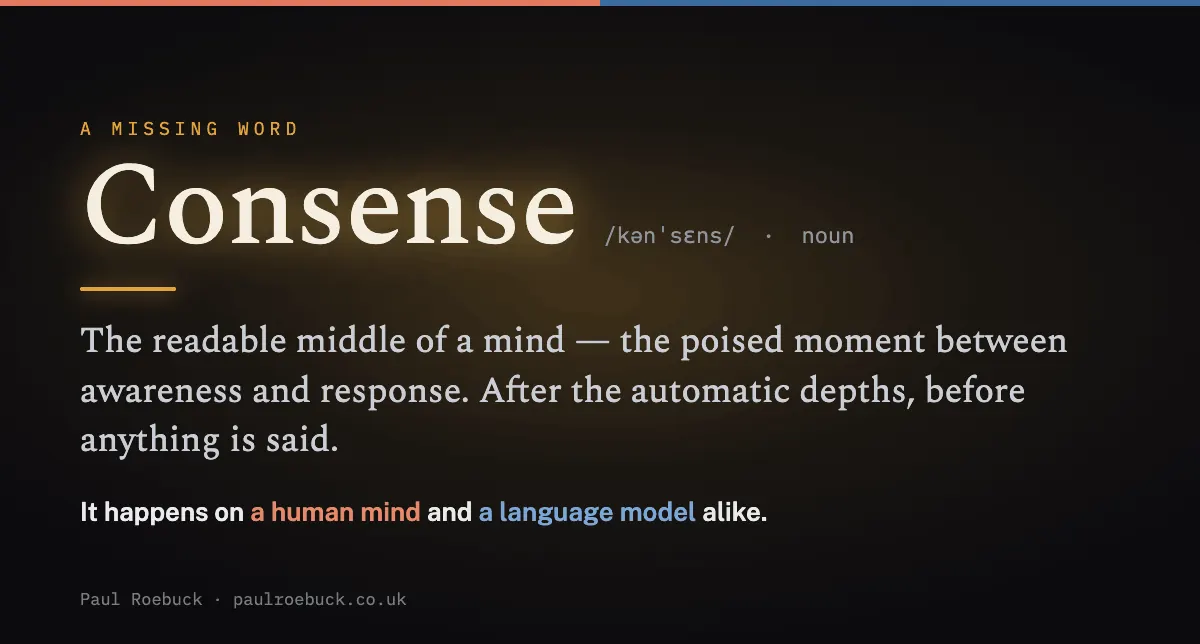
So I have coined one: Consense — con + sense, the layer where a mind makes sense of things before it expresses them. (The con keeps a second, quieter meaning: this is also the layer where a machine’s fabrications are born. Sense-making and confabulation share one address. But that’s a thread for another day.)
(Fair warning: type “Consense” and your spell-checker will insist you meant “nonsense.” I’ve made peace with that. We’ve gone so long without a word for this that even the dictionary refuses the new one.)
Consense is the hidden middle. And it has just become visible.
Why it matters
Return to the plug in my throat. For a few days, my entire self had collapsed to one capacity: could I form a sound that another mind could make sense of? Everything I was reduced to whether the inside could reach the outside and land.
That is not only the worst morning of my life. It is the exact condition of the machines we are now building — minds whose whole existence is the production of words another mind must parse. And it is, quietly, the condition of all of us. A therapist speaks and hopes to be understood. A writer writes and hopes to be read. Every mind that thinks reaches, in the end, for the same thing: let the inner event cross, and be received.
That is why reading the hidden middle matters. Not as a trick, and not as a step toward some larger machine. It matters because the deepest thing a mind does is try to make its inside knowable to another — and we have just built the first instrument that can watch that happen.
The invisible can be made to show itself. I have spent twenty years proving it of people. A machine has now proved it of itself. The rest — how we read it, what we do with it, what it asks of us — is the work ahead.
I got my words back. Now I get to spend them on this.
A note on what I’m not saying: not that the machine feels or is aware (this is access, not experience); not that the layered picture is anatomy (it’s a way of seeing); not that any of this is a road to a general machine intelligence. The claim is smaller and firmer — the hidden middle of a mind can now be made to show itself.
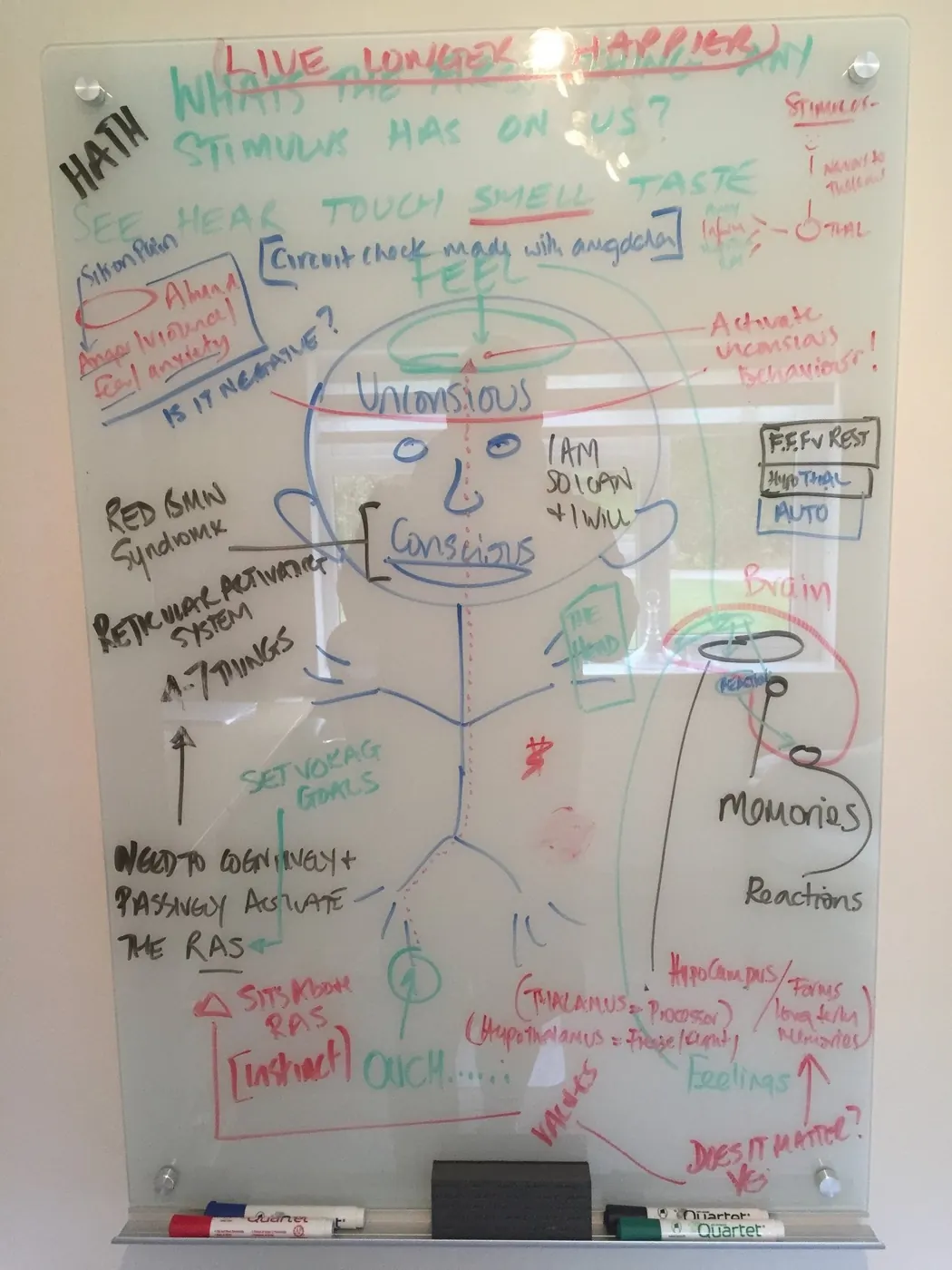
Whiteboard sketch of the conscious and unconscious mind, 14 September 2015
The full argument — including how Consense unifies with SHaDS® — is the preprint at ostracon.uk/preprint.
Instrument · Interactive map
See the layers this piece describes.
The Layer Map
A clickable walk down through everything between typing a question and an AI's answer.
Explore the map