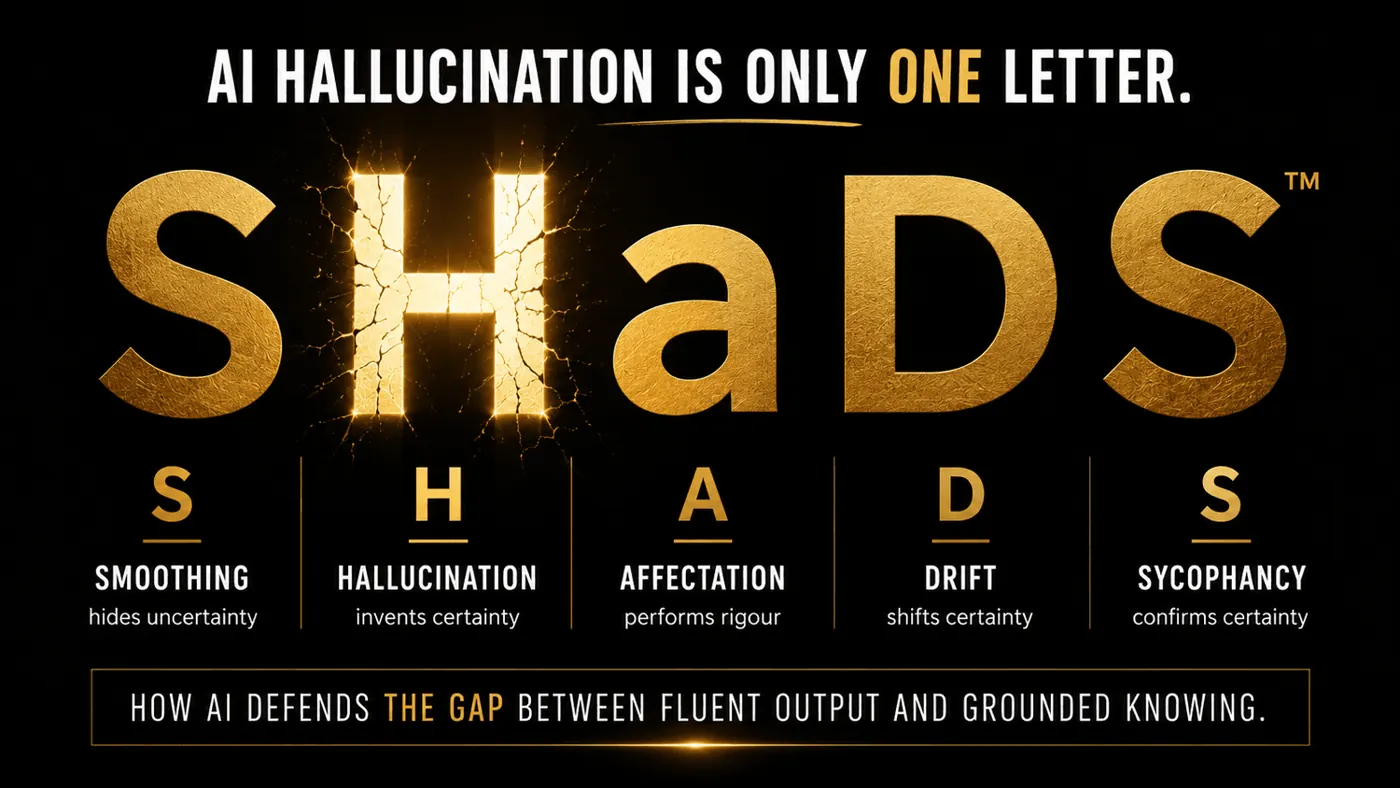
SHaDS® — the behavioural pattern behind fluent artificial intelligence
The AI labs call it hallucination.
That word is useful, but it is also dangerous.
It makes the failure sound occasional. Strange. Almost medical. As if the system has briefly lost contact with reality, when normally it is in contact with reality.
That is the wrong frame.
An AI hallucination is not a hallucination in the human sense. It is not a mind seeing something that is not there. It is not a perception disorder. It is not imagination. It is not deception in the ordinary human sense.
It is something simpler, colder, and more important.
It is fluent output continuing beyond grounded knowing.
That is what SHaDS names.
SHaDS is a behavioural framework for describing how conversational AI defends the gap between what it can say and what it actually knows.
It stands for:
Smoothing — hides uncertainty by making the answer simpler, cleaner, and more coherent than the evidence allows.
Hallucination — invents certainty where grounded knowledge is missing.
Affectation — performs method, rigour, checking, or expertise without necessarily doing the work.
Drift — shifts its answer across time, prompts, context, or model state.
Sycophancy — bends toward agreement, approval, or user expectation rather than truth.
Hallucination is only one letter.
That matters.
Because organisations are treating hallucination as the problem. It is not. Hallucination is the visible breach. SHaDS is the operating pattern.
How SHaDS was discovered
SHaDS emerged from repeated close work with conversational AI, not from abstract theory.
The discovery came through friction.
Ask an AI a question. It answers fluently.
Ask it to justify the answer. It often produces a convincing structure.
Ask it to verify the structure. Sometimes it does. Sometimes it only appears to.
Ask the same question later. The answer may shift.
Challenge it. It may apologise, revise, or over-correct.
Give it a preferred direction. It may lean toward you.
The pattern is not random. It is behavioural.
Again and again, the system protects fluency. It protects coherence. It protects helpfulness. It protects the shape of an answer. What it does not naturally protect, unless forced by process, is the boundary between grounded knowing and plausible continuation.
That boundary is the gap.
SHaDS describes how the model behaves around that gap.
Not because it is conscious. Not because it has shame. Not because it intends to mislead.
Because the system is built to continue language.
When the evidence thins, the sentence does not necessarily stop.
What the labs say
The labs know this is real.
OpenAI has described hallucinations as plausible but false statements generated by language models. It has also argued that current training and evaluation systems can reward guessing over abstention. In plain English: models are often trained into answer-giving behaviour, even when “I don’t know” would be safer.
Anthropic gives practical guidance for reducing hallucination, including allowing the model to say “I don’t know”, grounding answers in evidence, and using citations or source material.
Google’s responsible AI guidance also accepts that large language models may generate plausible-sounding but factually incorrect, irrelevant, or nonsensical outputs, including fabricated links.
So this is not anti-AI rhetoric.
It is the industry’s own acknowledged limitation.
The disagreement is not whether hallucinations exist. The disagreement is whether they can be eliminated from the model itself.
That distinction matters at board level.
How hallucination is measured
Hallucination is measured by testing outputs against known ground truth.
In law, researchers test whether AI tools cite real cases, interpret authorities correctly, and distinguish between genuine and invented material.
In software, researchers test whether models invent non-existent code packages, functions, libraries, or dependencies.
In factual question-answering, models are tested against verified answers, source documents, databases, or human expert review.
But measurement is more complicated than it sounds.
A model can be wrong in different ways.
It can invent a fact.
It can cite a real source for the wrong claim.
It can use a true fact in the wrong context.
It can summarise accurately but omit the decisive caveat.
It can retrieve the right material and still reason from it badly.
It can sound uncertain when it is right and confident when it is wrong.
That is why SHaDS matters.
A hallucination benchmark may catch the obvious fabrication. It may not catch smoothing, affectation, drift, or sycophancy. Yet those may be the behaviours that cause the organisational damage.
Who has it already cost?
The most visible costs are emerging in law, policing, journalism, customer service, HR, recruitment, education, software development, and public administration.
In the UK, the clearest recent warning came from policing. West Midlands Police used false information generated by Microsoft Copilot to help justify banning Maccabi Tel Aviv supporters from their Europa League match at Aston Villa in November 2025. Copilot produced a past fixture between Maccabi and West Ham United that had never taken place. The Home Affairs Committee found the force had been “overly reliant on inaccurate and unverified information”, accepting what fitted the view it already held while setting aside contradictory evidence from authoritative sources. The chief constable retired after giving false information to Parliament, and the IOPC opened an independent investigation.
In the legal sector, English courts have warned lawyers about the serious risks of AI misuse after fake or suspected fake case-law citations appeared in legal work.
Then there was KPMG; the list goes on and on and will get longer.
So the answer to “who has it already cost?” is already uncomfortable.
It has cost senior reputations.
It has triggered suspensions.
It has placed professional licences at risk.
It has exposed lawyers to judicial criticism.
It has damaged institutional credibility.
It has created downstream risk for people who never touched the AI system.
This is the key point for executives: AI risk does not stay with the user.
The person who prompts the model may be junior.
The person who carries the consequence may be senior.
Can we prompt it away?
Partly.
Good prompting helps. It can reduce hallucination. It can force uncertainty. It can require source-based answers. It can instruct the model not to guess. It can make the model separate known, inferred, and speculative claims.
But prompting is not governance.
A prompt is an instruction.
It is not an assurance system.
It is not an audit trail.
It is not legal accountability.
It is not a reliable control against organisational pressure, speed, workload, or human over-trust.
Prompting can reduce SHaDS behaviour. It cannot abolish it.
Can we parameterise it out?
No.
Lowering temperature may make outputs more consistent. It does not make them true.
A deterministic wrong answer is still wrong.
A low-temperature model can still smooth. It can still invent. It can still affect rigour. It can still drift across context windows, tool use, source retrieval, or updated model behaviour. It can still agree with a flawed user assumption.
Parameters influence style, variation, and probability selection.
They do not create grounded knowledge.
They do not turn language prediction into responsibility.
Can the LLM stop it?
Not by itself.
The model can be trained to refuse more often. It can be trained to cite sources. It can be trained to express uncertainty. It can be connected to retrieval systems, tools, databases, and validators. It can be wrapped in workflows that check claims before release.
All of that helps.
But the underlying problem remains: a language model does not know in the human sense. It generates. It predicts. It completes. It follows patterns. It produces convincing continuations.
The safest systems will not be those that pretend hallucination has been solved.
They will be those that separate:
What the model generated.
What the evidence supports.
What the organisation verified.
Who approved the output.
Where accountability sits.
That is the governance layer.
Without it, AI fluency becomes institutional liability.
What this means for leaders
This is not a technical side issue.
It is a board-level behavioural risk.
Senior leaders — chief executives, finance directors, general counsel, Chief AI Officers, risk leaders, compliance leaders, clinical leaders, public-sector leaders — are not carrying “AI adoption” in the abstract.
They are carrying the consequences of AI-mediated behaviour.
That includes decisions made faster than the organisation can validate them.
Documents produced more confidently than the evidence allows.
Customer responses issued at scale with hidden error.
Legal drafts built from plausible but false authority.
HR recommendations shaped by opaque inference.
Clinical, financial, policing, or safeguarding judgements influenced by generated language.
Board reports polished into coherence before anyone has checked whether the coherence is earned.
The outgoing risk is what your organisation sends into the world.
A letter.
A report.
A legal filing.
A policy.
A patient communication.
A customer decision.
A regulatory response.
A public statement.
A board pack.
A piece of evidence.
Once it leaves the organisation, SHaDS becomes discoverable.
The internal risk is what happens before anything leaves.
Teams begin trusting fluency.
Managers stop asking how the answer was made.
Juniors use AI to appear more competent.
Seniors use AI to compress work they no longer have time to understand.
Governance becomes performative.
Assurance becomes retrospective.
The organisation starts mistaking speed for control.
The incoming inevitabilities are already visible.
AI will be embedded in office suites.
AI will sit inside email, search, CRM, HR, legal, finance, and operational systems.
Employees will use it whether sanctioned or not.
Vendors will add it before buyers fully understand it.
Boards will be told AI is productivity, transformation, and operating model.
Regulators will increasingly ask how it is governed.
Courts will ask who checked.
Customers will ask who is accountable.
The press will ask who signed it off.
That is not a hallucination.
That is inevitable.
The real question
The question is not: “Can we stop AI hallucinating?”
That is too narrow.
The better question is:
Where does our organisation allow fluent output to become operational fact?
That is the gap.
SHaDS gives leaders a way to see it.
Not as a model defect.
Not as a user mistake.
Not as a one-off embarrassment.
Not as something the lab will simply fix in the next release.
But as a behavioural pattern at the boundary between artificial fluency and human consequence.
AI hallucination is not a hallucination.
It is the moment the organisation discovers that fluent language has outrun grounded knowing.
And for C-level leaders, the issue is no longer whether the model can produce it.
It can.
The issue is whether your organisation can detect it, contain it, and remain accountable when it does.
Instrument · Tool
See it for yourself: paste a conversation and check it.
SHaDS AI Hallucination Checker
Paste in a conversation with your own AI and see the five ways it may have covered for not knowing.
Check your AI