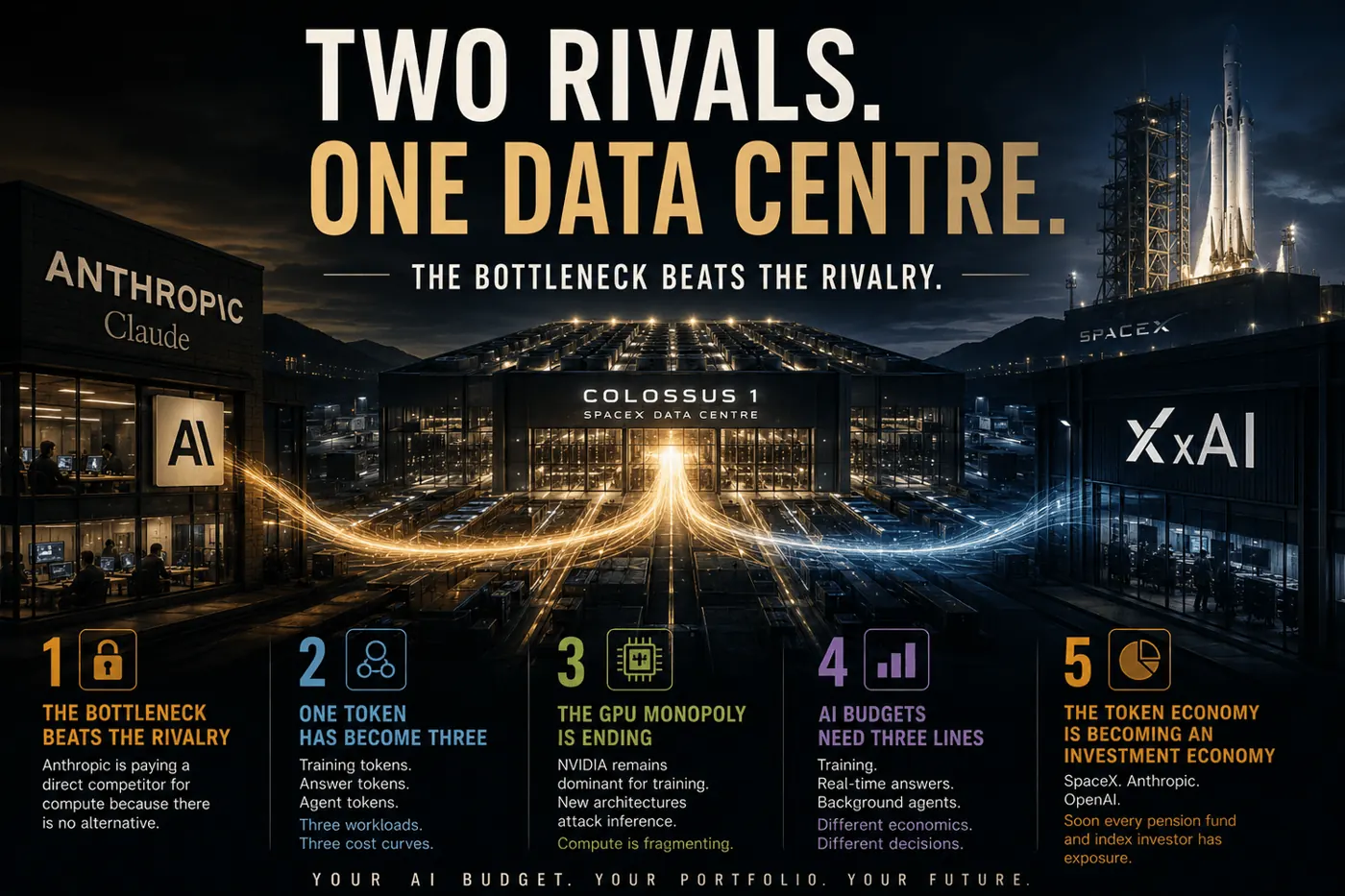
Anthropic is paying SpaceX $1.25 billion every month — to rent compute from its direct frontier rival. What that deal says about token cost, hire-versus-deploy, and the capital markets event most senior operators have not yet registered.
For senior operators carrying real load on the compute, cost, and capability question — directors, VPs, partners, heads of function, founders running lean.
TL;DR
Anthropic pays SpaceX $1.25 billion every month to rent compute from its direct frontier rival. The contract is — legally — a 180-day lease, not a four-year arrangement. Meanwhile that rent underwrites Colossus 2, the data centre xAI will use to train the model that competes with Claude. The GPU monoculture is breaking. Token cost is splitting into three different curves, and your make-vs-buy decision splits with it. SpaceX IPOs ahead of Anthropic and OpenAI; many readers will soon hold all three through pensions and index funds. Token literacy stops being optional.
Read this if:
• You’re a senior operator who has not yet looked at AI compute as a budget line on its own.
• You’re starting to make hire-versus-deploy decisions in your function and the maths feels new.
• You hold pensions, index funds, or any portfolio exposure that is about to include three of the biggest IPOs of the decade.
Anthropic is paying SpaceX $1.25 billion a month.
SpaceX’s IPO filing reports that arrangement as a potential revenue stream of more than forty billion dollars through May 2029. Anthropic uses the capacity to run inference for Claude Pro and Claude Max subscribers.
But Elon Musk has been clear about what that figure actually represents. The legal commitment is a 180-day lease, with 90-day mutual cancellation rights after that. Musk has said publicly: “if compute gets super tight, we might need it back.”
The forty-billion-dollar number is a ceiling, not a floor. Anthropic is paying $1.25 billion a month for capacity its direct frontier rival can repossess at six months’ notice.
Meanwhile Musk uses Anthropic’s money to build Colossus 2. Colossus 2 is gigawatt-scale, Blackwell-only, purpose-built for frontier training. It is the data centre on which xAI will train the next model that competes directly with Claude.
Read that twice.
Anthropic is renting compute from the man who is using their rent to build the data centre he intends to use against them — on terms that let him take the compute back whenever he wants it.
Why this happened
Because there is nowhere else to go.
ASML in the Netherlands is the sole supplier of extreme ultraviolet lithography — the machines without which leading-edge chips cannot be made. They produce roughly fifty systems a year. TSMC and Samsung are the two foundries running at the frontier. New fabs take three to five years to build. NVIDIA can only ship as fast as TSMC can fabricate.
When supply is bound at the source, the choices downstream collapse. You take what is available. You sign a forty-billion-dollar contract with the man building the next data centre that will out-compute you, because the alternative is having no data centre at all.
Two adversaries. One contract. The lab is paying its competitor’s owner rent — and funding his next build at the same time.
The bottleneck has overruled the rivalry.
That is not a metaphor. It is a market signal. When competitors fund each other’s frontier infrastructure, the constraint has become more binding than the competition. The constraint is structural, not transient.
The GPU was a gaming chip
There is a second story underneath the supply story. Most senior operators have not registered it yet.
The chip the world is racing to buy was designed for video games.
NVIDIA built the GPU — the graphics processing unit — in the 1990s to render polygons for computer graphics. It turned out, more or less by accident, that the mathematics required to render polygons is closely related to the mathematics required to train neural networks. Both are massive parallel multiplications. NVIDIA got lucky.
That accident is what put NVIDIA at the centre of the AI economy. It is also why every AI lab on earth has been queuing for the same chip. There has been no alternative.
That is changing.
Cerebras has just gone public on the back of a wafer-scale chip — a single piece of silicon roughly fifty-eight times larger than a GPU — claiming inference speeds many times faster than a GPU on the workloads that matter. Groq has its own purpose-built architecture in NVIDIA’s distribution pipeline. AWS, OpenAI, Notion, GSK, the Mayo Clinic are named customers.
The post-GPU chip is being designed on purpose. The monoculture is ending.
And the moment the monoculture ends, the price of a token stops behaving like a single number.
Three kinds of tokens
Compute, until recently, was treated as a single category. You bought tokens. They cost roughly x per million. The price drifted down each year, the way software costs have always drifted down.
That mental model is now wrong.
There are three different kinds of work an AI model does, and the silicon that handles each is diverging.
Training tokens. What a lab consumes to build a model in the first place. Requires the absolute frontier of chip performance, vast bandwidth, expensive interconnects. NVIDIA stays dominant. Training tokens stay expensive.
Real-time answer tokens. What gets consumed when a human types a question and waits for the answer. Speed is everything; the user is sitting there. Cerebras, Groq, and the new architectures win on this workload. Real-time answer tokens are collapsing in price as new chips ship.
Background agent tokens. What gets consumed when an AI agent runs a job overnight, no human in the loop. Latency does not matter. The agent will sit on a result for hours and no one is inconvenienced. This workload can run on the cheapest good-enough silicon, in the most-constrained locations — and credible analysts are now openly proposing that some of it ends up in racks orbiting the planet.
The Anthropic / Colossus 1 deal makes the split visible inside a single contract. Colossus 1’s mixed-chip architecture is too inefficient to train Grok on. So Musk monetises capacity he cannot fully use himself by renting it to Anthropic for inference. Anthropic gets answer-token capacity for Claude Pro and Claude Max subscribers. Their own premium clusters stay free for training. The deal is the architectural argument in concrete form.
One token price has become three. And the three are moving in different directions.
Three make-vs-buy calculations
This is where it stops being a tech story and starts being a budget story.
For most of the last two decades, the make-vs-buy decision in white-collar work was a single question — hire someone, or contract it out. AI changed that to a different question — hire someone, or deploy an AI. Now, with the three-way split in token economics, the decision is three questions, not one.
For frontier reasoning work — original analysis, judgement-heavy decisions, the things you would normally give to a senior associate or an executive — token cost stays high. The premium chips required are scarce. The hard-nosed business people reading this will hold the line on hiring humans for this category longer than they expect to.
For real-time human-facing work — customer chat, internal copilots, voice interfaces — token cost is falling fast. Deploy the AI sooner than you think. The economics will move under you.
For background agent work — overnight processing, multi-step task chains, batch analysis, anything where a human is not waiting — token cost will fall the hardest. The chips required are the cheapest. The data centres they run in can be in the most-constrained locations. This is the category where the cost line on your P&L stops looking like salary and starts looking like electricity. Entire job categories will move into this lane within twenty-four months, because a person cannot compete with electricity for repetitive multi-step work.
That last category is the one most senior operators have not yet modelled. They are still budgeting as if a token has a single price, and as if hire-versus-deploy is still a binary decision. It is now a three-line decision, and the three lines do not move together.
The IPO trap
There is one more thing.
SpaceX is going public ahead of both Anthropic and OpenAI. The infrastructure provider IPOs first. The frontier model labs follow.
That is the gold-rush pattern, perfectly executed. Levi Strauss before the prospectors. The company selling jeans to the diggers goes public while the gold companies are still in private financing rounds, because the jeans company has the most certain cash flow.
The line on the SpaceX S-1 that makes that IPO work is Anthropic’s rent. $15 billion a year, projected through May 2029.
That projection is — legally — a 180-day lease with 90-day cancellation rights either side. The S-1 discloses the termination clause. Musk has said publicly that he may need the compute back. The four-year cash flow underwriting a $2 trillion valuation request is, in contractual reality, a six-month tenancy. Investors are being asked to value the option, not the contract.
Within twelve months, every reader of this paper will hold direct exposure to all three vertices — SpaceX, Anthropic, and OpenAI — through pension funds, private equity portfolios, and the ordinary index funds in retirement accounts. The token economy stops being something an operator decides about. It becomes something a shareholder is exposed to.
Most shareholders will not know it. The disclosures will not be that clear. But the dollar flows are already visible to anyone who reads an annual report carefully.
Get fluent now
Three years ago, no senior operator thought about compute when they thought about strategy. Compute sat alongside office paper supply — important but solved. Procured.
It is now a board-level question, a budget-line question, and a capital-allocation question, simultaneously.
Anthropic just demonstrated this at the frontier. They did not wait. They locked in capacity with their competitor, paid him to build the next data centre that will compete with them, and made the bet that there was no other option.
The hard-nosed business people reading this will recognise the move. It is the same move you make when a key supplier’s price doubles and you book the next two years of inventory at today’s rate.
The cameras are on. The principle is on the page.
The bottleneck has overruled the rivalry. The token economy has three lines, not one. And your retirement portfolio is about to vote on all of it.
This is Additional Intelligence™ (my term for AI as a working partner) at work — not as a productivity tool, but as a capital category.
Get fluent now.
Concept and content: Paul Roebuck. Words drafted with Claude (Opus 4.7); images with ChatGPT.
P16
Instrument · Interactive map
Walk down from the chat box to the silicon.
The Layer Map
A clickable walk down through everything between typing a question and an AI's answer.
Explore the map