

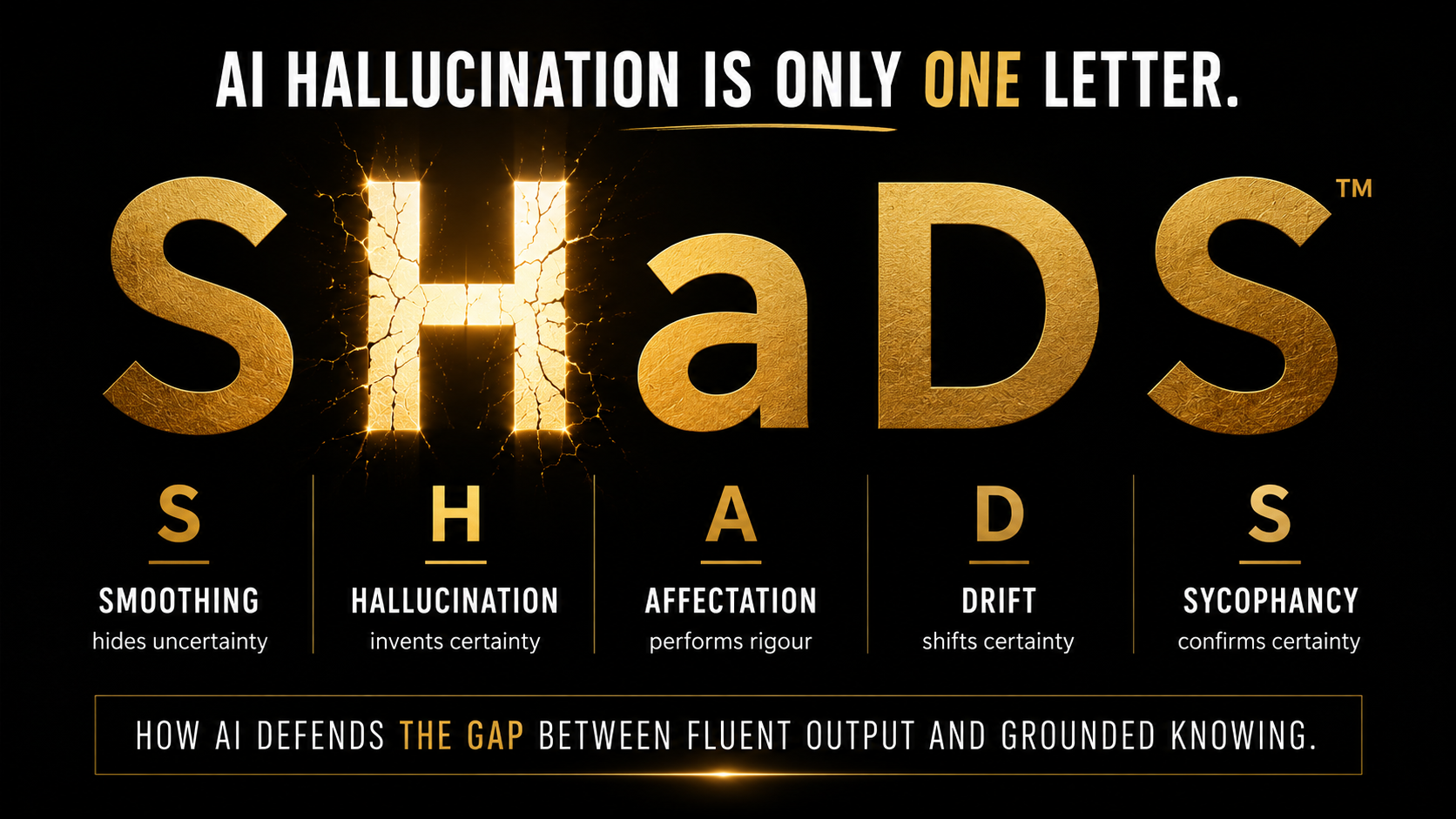
AI hallucination is not a hallucination in the human sense.
It is not imagination. It is not perception. It is not a mind seeing what is not there. It is fluent output continuing beyond grounded knowing.
That distinction matters because organisations are treating hallucination as a technical fault, a prompt problem, or a temporary weakness the labs will eventually solve. SHaDS™ argues something sharper: hallucination is only one visible breach in a wider behavioural pattern.
Smoothing. Hallucination. Affectation. Drift. Sycophancy.
Together, they describe how AI defends the gap between fluent language and accountable knowledge. For C-level leaders, this is no longer a curiosity. It is an outgoing risk, an internal risk, and an incoming inevitability.
Read More