Ask a salesperson something they don’t know three days before the number is due, and watch what happens. They almost never say I don’t know. They fill the gap, or they shrink from it.
I have spent forty years watching people do that — not with fists, with shape. And when I turned the same attention on AI, it was doing the identical thing. SHaDS® names the five ways a machine defends a gap rather than admit one. APC — Adaptive Pressure Calibration — reads the same move in the person.
This page is for two people: the sales executive who has to carry a number, and the manager who has to decide where to put them and how hard to push.
A dial, not two boxes
Hunter and farmer are two holes. Most organisations sort people into one or the other, then wonder why a capable person keeps underdelivering — because people do not come in two shapes. You end up hammering the wrong peg into the wrong hole and calling the result a performance problem.
APC measures instead of sorting. Not which box, but where on the dial: where someone naturally sits, which way they go when they hit something they cannot answer, and how far they travel when the number is due. The two poles are real. Almost nobody lives at one.
Two ways out of not knowing
When someone hits a gap they cannot fill — a question they cannot answer, a quarter they cannot save — they rarely sit in it. They leave in one of two directions.
Inward. The fault is mine. I should have prepared harder. I called this NGE — Not Good Enough.
Outward. The fault is the lead, the price, the market. Next. That is FOF — Fear of Failure.
Underneath both is shame, not fear. Guilt says I did something wrong. Shame says something is wrong with me. It is not two kinds of people. It is one system with two exits.
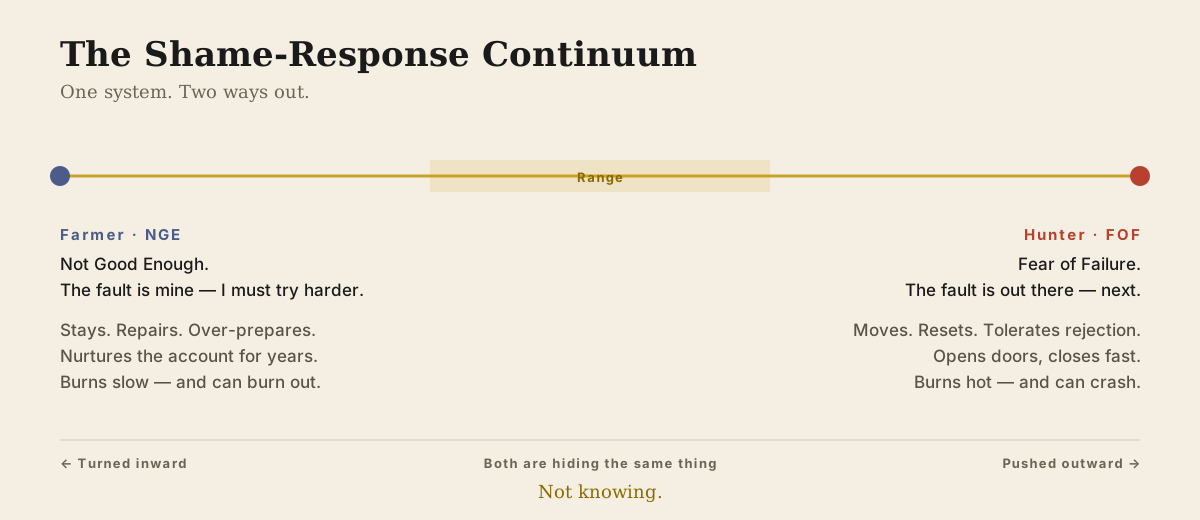
In sales language: Farmer and Hunter
Sales already has words for the two ends of the dial, and treats them as two kinds of person. The hunter opens doors, tolerates rejection, closes fast, resets. The farmer stays with the account, over-prepares, nurtures for years, avoids the rejection rather than absorbing it. Useful shorthand — and the place the sorting starts.
Hunter is FOF. Farmer is NGE. The hunter needs the outward default — every rejection has to land somewhere that is not them, or they could not make the next call. The farmer’s dissatisfaction is the engine that makes them thorough. Each is a shame strategy doing useful commercial work.
The part people get wrong
Hunters are not FOF people. Farmers are not NGE people. Hunting and farming are roles that reward different shame strategies. Put a strong internaliser in a cold-calling seat and the rejection lands on them, every time, all day. That is not a weak salesperson. That is a mismatch.
The hunter–farmer language comes from the psychotherapist Thom Hartmann, who used it about ADHD. This work builds on that.
For managers: the peg, the hole and the hammer
When someone capable keeps underdelivering, there are only three places to look.
The fix is usually not a new peg. It is a recalibration, or a realignment. The problem is rarely in the person. It is in the mismatch.
What the calibration reads
A personality test tells you what someone is like on a calm Tuesday. This reads what they become when the quarter is closing.
- Direction — which way they go when they hit a gap: inward or outward.
- Baseline — where they naturally sit on the continuum.
- Drift under pressure — how far they move when the number is due, and which way. This is the part no personality test gives you, and it is the part that predicts who breaks in the wrong seat.
- Recovery — how quickly they come back after a knock.
- Range — how much of the spectrum they can reach when they need to. This is the leadership variable.
- Role fit — whether peg and hole agree, or pull apart.
The questions never say hunter or farmer, so nobody can play to the answer they would rather give.
What comes back
For a person: their pole, the direction they drift under pressure, how far, how fast they recover, and a plain verdict on whether the seat fits.
For a team: the real distribution of hunters and farmers, the mismatches, who is carrying risk under target pressure, and where to coach with the grain instead of against it.
The useful cases are where three readings disagree: what the role expects, what the manager predicts, and what the instrument finds.
What this is not
Not a clinical test. Not a diagnosis. Not a hiring gate, and not a reason to label anybody.
And not a validated instrument. The axis it sits on is sixty years old and well corroborated in the literature. What is new here is the sales-context reading and the pressure-drift dimension — and that has not been tested at scale yet. It would be a poor advertisement for a page about people who cannot say I don’t know if I claimed more than I can show.
The tools
Calibration
Hunter & Farmer
Ten minutes, on your own phone. Which are you — and which do you become when the number is due? Nothing you enter leaves your browser.
Paper
What APC is
The longer account: what it calibrates, what it refuses to claim, and the sixty years of work underneath it.
Manager tool
Manager Ratings
Rate your people on the dial, fast, before they answer anything. Names stay on your device. Needs a password.
A read on your team
Team calibrations are arranged directly with me, usually alongside a training session. A first picture takes about nine days: a short blind round to tune it, then the real one. Nothing onerous, nothing clinical, and yours to stop at any point.
The same failure in the machine → Not good enough, never my fault → All instruments →