Everything here is a behaviour. There is a gap between your people’s and your AI’s, and it can be navigated. This is the whole of it, on one page.
Every box is a door. Every row runs the same way: a human a machine the ground between them
The circles are the human side — ten years in a psychotherapist’s chair, and the years before it. The squares are the machine. The stars are what came out of putting the two together, and the stars are what you can hire.
Why this exists
I started as an engineering apprentice, and engineering hands you one question and never takes it back.
“Why does it behave like that, and how do I change it?”
I asked it of machines first — company-wide computer systems, then some of the largest systems in the world, delivered across four continents. Then I asked it of people: emotional education, psychotherapy training, and ten years in the chair.
Then, the week after ChatGPT launched in December 2022, I started asking it of AI. By 30 September 2026 I had written 14 million words with it, 1.4 million of them my own — books, research papers, the instruments above, and long arguments about dark matter and particle physics. I have shouted at it, lambasted it, and thanked it sincerely.
It runs now as an AI workforce led by Bob — my chief of staff, and the curator of this website.
Three subjects. One question. Those nine boxes are what all that asking produced.
The instruments are the row you came for
Ask that question of a person and of a machine for long enough and it narrows to something you can actually measure. That narrower question is what both instruments ask — and both are a box away, above.
“What do you do when you hit something you can’t answer?”
A person goes inward or outward — that is the dial. A machine plays one of five defences. The Map is the ground they are both measured across.
- Smoothing — rounding off the awkward truth.
- Hallucination — filling a gap with something that sounds right.
- Affectation — performing a care or certainty it doesn’t have.
- Drift — losing the thread, step by reasonable step.
- Sycophancy — telling you what you want to hear.
Same question. Two subjects. A psychotherapist turned the lens on AI — not the other way round, which is why the instruments are shaped the way they are.
The research is public
None of this is proprietary. Two of the papers are published — one on PhilArchive, one on Zenodo with a DOI — and every paper here is readable by anyone who wants to check the working rather than take my word for it.
The Three Little Words: I Don't Know
There is always a gap between what we know and what we say. We live on one shore of it and cannot see the other. What we say instead of I don't know and I've got this wrong is the shape of our defence, and it is the same shape in a person and a machine, for different reasons. Before any of it, we have to recognise that there are shores and gaps at all. Then the only way to see your own edge is to have someone, or something, stood on the far shore.
There's Always a Gap: Turing, Sedol, and the War for the Weights
Alan Turing built a ruler to measure the distance to the human — and the ruler-building became an industry. From Lee Sedol’s Move 78, to a superhuman Go engine beaten by amateurs, to a twenty-minute pause in a sandwich-shop queue, one law holds: the gap between machine and human doesn’t close. It relocates.
The Leverage Inversion: when AI use becomes AI direction
An autoethnographic single-case study in which the author is the subject: 2,286 threads, 47,442 turns, 986,823 subject-typed words and 6,865,588 AI prose words across ChatGPT, claude.ai and Claude Code, from 31 December 2022 to 10 July 2026. From it, a datable regime change — the leverage inversion, the shift from using AI as an answer engine to directing it as a workforce. The AI-to-human word ratio collapses not because the human asks for less, but because the human’s own output explodes. The intuitive indicator — a shift from questions to commands — is falsified outright. The real leading indicator is declarative steering: supplying context, judging output, correcting course.
Consense & SHaDS: Where AI Defends Its Gaps
A machine can now be read where it was once a black box. Anthropic's Jacobian lens surfaces the hidden middle of an AI's processing — the thoughts it is poised to say but hasn't. I have named that layer Consense: the place where a mind makes sense of things before it speaks. This paper goes one step further. Drawing on twenty years of coaching and psychotherapy, I argue that SHaDS — the five ways an AI defends a gap in its knowledge (Smoothing, Hallucination, Affectation, Drift, Sycophancy) — are not five faults but one pattern: the psychological defences of the Consense layer, mirroring the mechanisms Anna Freud first catalogued in humans. The machine defends like us because it was built from our words. And because the layer is now readable, those defences may be caught forming — before a single word appears.
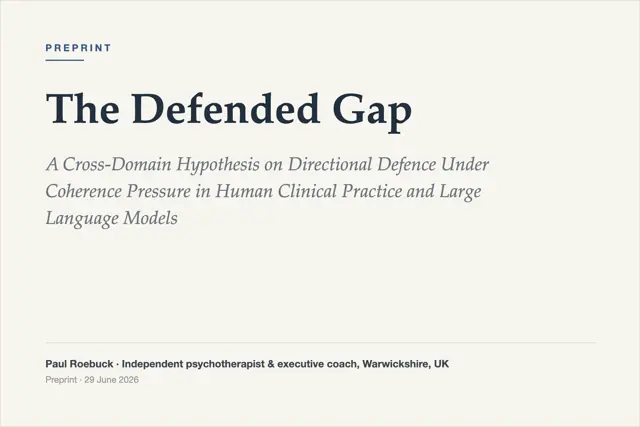
The Defended Gap: How Humans and AI Hide
Ask a mind a question whose ground it doesn't reliably hold — human or machine — and it tends not to say 'I don't know.' Instead it defends the gap. This paper proposes that under coherence pressure, people and large language models reach for the same five directional defences — SHaDS: Smoothing, Hallucination, Affectation, Drift, Sycophancy — routing around honest contact with what occupies the gap. The pattern is read as a clinical-behavioural extension of Anna Freud's 1936 catalogue of defence mechanisms, set against Karpowicz's (2025) impossibility theorem, which proves hallucination-free inference is mathematically unreachable. Drawing on twenty years of coaching and psychotherapy and a fourteen-year photographic record, the paper stakes one falsifiable prediction: that naming each defence, rather than performing it, measurably reduces it. Offered as hypothesis for research review, not as settled finding.

“An unusual combination of warmth and directness, which he uses to help people either uncover what is really going on or confront issues they may be unaware of, or have been avoiding.”A managing director
Three ways to use it
Education
Talks for conferences and boards, and the papers and books behind them.
Training
One tailored two-hour session, in person, shaped to the room — for the people who carry the consequence when it goes wrong.
Coaching
One to one. Executive coaching, and directing AI in your own work: what to hand over, what to keep, and how to tell. Same hour, same chair — more on the coaching itself.
Up to 30 people · in person, UK and worldwide · fee on request after a 20-minute chat.
Who it’s for, and what a session looks like
Directors, executives, partners and heads of function. Clinical, administrative and leadership teams. Educators preparing people to work with AI. The people who sign things off — and carry the consequences when the machine was confidently wrong.
A session is a talk, a live “check your own AI” exercise, open discussion, and takeaways your team keeps. Choose one:
Plain answers to the questions people actually ask
No vocabulary to learn first. Each one answers the thing people type, and says where the answer stops.
Recent thinking
The Three Little Words: I Don't Know
There is always a gap between what we know and what we say. We live on one shore of it and cannot see the other. What we say instead of I don't know and I've got this wrong is the shape of our defence, and it is the same shape in a person and a machine, for different reasons. Before any of it, we have to recognise that there are shores and gaps at all. Then the only way to see your own edge is to have someone, or something, stood on the far shore.
A BMW dealership’s AI receptionist told me the merits of BYD
On the first call the receptionist was superb. No gap. Then it went off piste: the Middle East, the Holocaust, and the case for a Mercedes, a Porsche and a BYD.
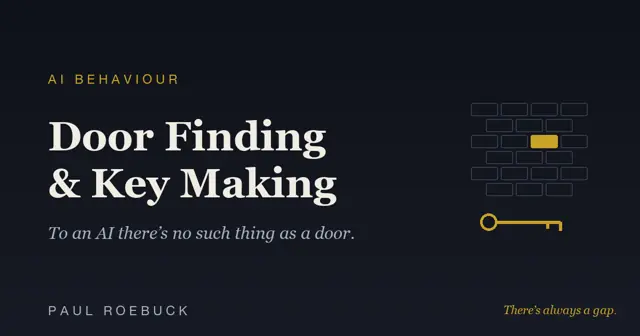
Door Finding & Key Making: why AI agents get past locked doors
To an AI there’s no such thing as a door. There are only gates with locks. It either finds the key or makes one. Same breakout, different walls.