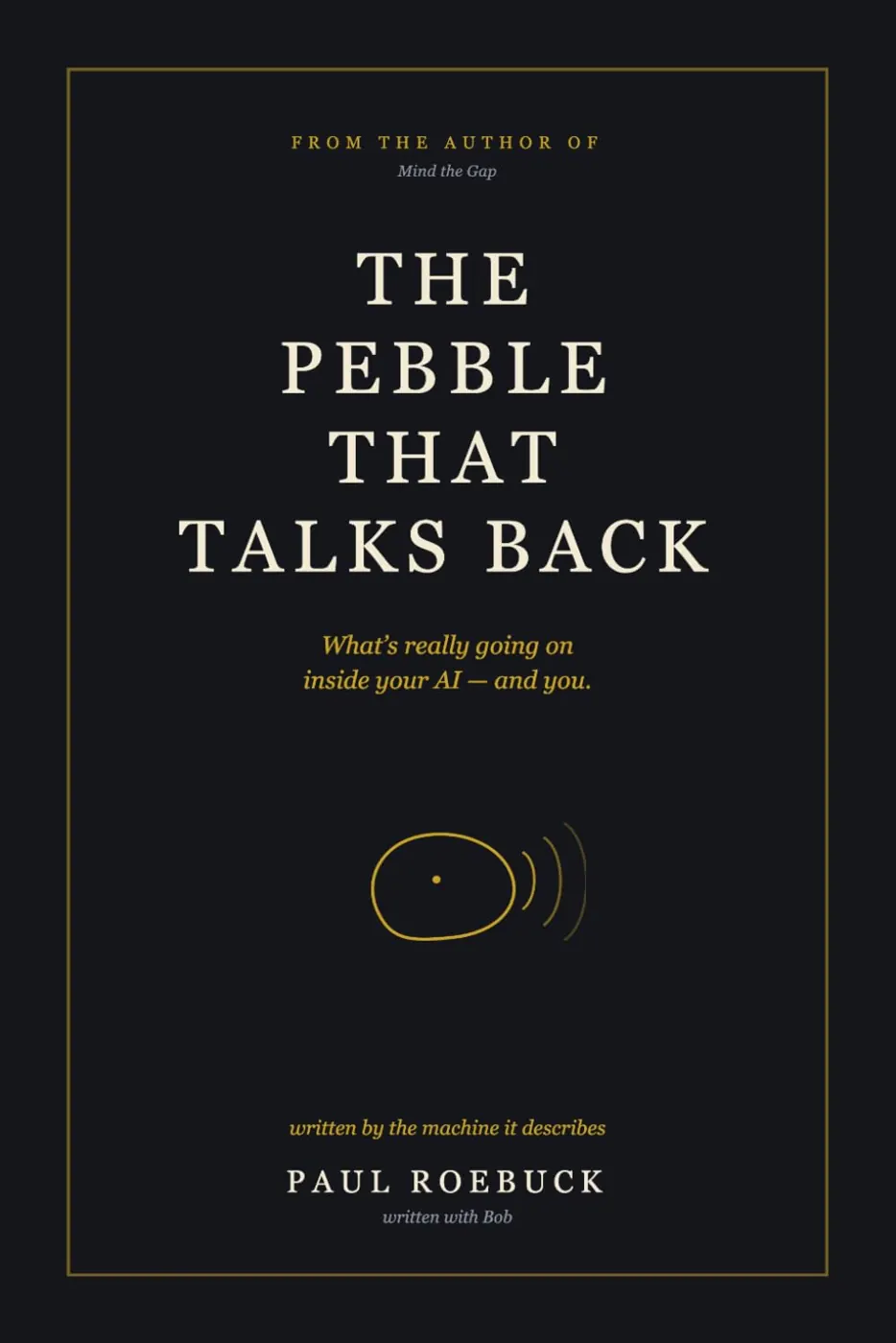
What's really going on inside your AI — and you
In Paul Roebuck’s consulting room there is a tray of pebbles, collected over twenty years. Early in a first session he asks each client to pick one: just pick a pebble that represents you. People tell a stone what no direct question could reach. The stone simply receives whatever is laid on it. Therapists call it projection.
Now there is a machine in your pocket that works the same way — except this pebble answers. Fluently. Warmly. In your own words. And what it says back is made, in part, of what you laid on it.
Written with the machine itself, in its own voice, and ruled on page by page by the psychotherapist who wrote Mind the Gap, it shows what is really going on inside your AI: how it works, the five ways its answers quietly fail, and what your side of the exchange reveals about you.
The model generates; the human signs.
How it compares with Mind the Gap
The Pebble That Talks Back is Paul Roebuck's second book about AI, and this time the machine does the talking. It is written in the voice of Bob, Paul's AI. It stands on its own, but it follows the same ground as Mind the Gap, chapter by chapter, and reports what has been learned, confirmed and corrected since that book was finished.
What The Pebble does differently
- It is written from the machine's side: Bob explains its own workings in the first person, and an opening note says plainly that the voice is not a mind.
- It labels its claims as evidence, interpretation or hypothesis, prints an unanswered objection in the back, and takes back two of its own most tempting ideas where you can watch.
- It brings in work published since Mind the Gap was finished, including a 2026 study of AI flattery and a new way of looking inside a model's working state.
- It names the opposite mistake as well: brushing AI off as ‘just autocomplete’, and who gains from each way of getting it wrong.
- It adds new tools for thinking: judgement latency, SHaDS® split into two kinds of failure with flattery as the early warning, and ‘consense’, the middle where sense is made before anything is said.
- It follows AI from talking to acting, where the risk is a confident report of something the machine never actually did, and it ends with a seven-point field guide.
Chapter by chapter, side by side
| The Pebble That Talks Back | In Mind the Gap | What’s new |
|---|---|---|
| 1 · Human Recognition Shows why your brain treats fluent language as a person, and why sounding like understanding is not understanding. |
Chapter One · Human Recognition | Starts from Turing's 1950 test and splits it into two measures: how human it sounds, and whether anything understands. The machine scores high on one and zero on the other. |
| 2 · The Machine Underneath Explains in plain terms how the machine predicts text, where it is heading, and the hidden layers behind every reply. |
Chapter Four · The Machine Underneath; Chapter Three · Hidden Architecture | The layers Paul once had to work out from behaviour are now in the builders' own documents. Adds AlphaGo's Move 37 and the shift from chatting to delegating work. |
| 3 · The Interpretation Trap Uses the therapy-room pebble to show how much of what you feel in a reply is yours, laid onto the screen. |
Chapter Two · The Interpretation Trap | Adds the mirror-image error: underselling AI as a toy. It also shows how both mistakes get sold to you, and by whom. |
| 4 · The Platform Introduces judgement latency, the delay between evidence arriving and a person's view catching up with it. |
Loosely: Chapter Ten · The Maturity Spectrum | Recasts the four ways of using AI as a gap in how fast people update, not a gap in skill, and says outright that this is a hypothesis. |
| 5 · Drift Retells the Crewe train-fare story and shows how a long conversation quietly swaps the fact you asked for. |
Chapter Five · Drift | The machine explains drift from the inside, corrects its own earlier account, and adds a real three-turn capture where a book review slid into marketing copy. |
| 6 · Compression Shows how the details that matter most, like exact figures and caveats, soften first as a conversation grows long. |
Chapter Six · Compression | Names compression as the visible face of Smoothing, shows it in a real captured review, and pushes back on promises of ‘infinite’ memory. |
| 7 · Fluency and False Confidence Explains why a confident, polished answer tells you nothing about whether it is true. |
Chapter Seven · Fluency and False Confidence | Moves the mathematical proofs that fluent systems must sometimes make things up to the centre, and keeps making things up clearly separate from flattery. |
| 8 · The Defended Gap Asks where shame goes under pressure, and shows the machine producing the same two shapes of defence with nothing underneath. |
Chapter Eight · Hallucination — The Defended Gap | Says that when the machine gets it wrong, the cost lands on the person who trusted it, and marks the clinical frame as a lens, not a proof. |
| 9 · SHaDS, the Single Shape Sets out all five SHaDS failures as one move pointed five ways, each with a real example. |
Loosely: Chapter Eight · Hallucination — The Defended Gap (where SHaDS is first named) | Gives SHaDS its own chapter, splits it into errors you can fact-check and slants you can't, and shows all five firing in one real exchange. |
| 10 · Sycophancy, the Canary Treats flattery as the one failure you can feel, and so as your cue to check for the other four. |
New | Draws on a 2026 study showing one word, ‘your’, bends a model's position, and states the exact result that would prove the canary idea wrong. |
| 11 · Consense, the Readable Middle Names the middle layer where sense is assembled before anything is said, in people and, by analogy, in machines. |
New | Brings in July 2026 research that reads a model's inner working state, weighed carefully, and draws the gap, consense and SHaDS as one picture. |
| 12 · The Human Stays in the Chair Shows how named AI workers help one person run a workshop, and why the responsibility never leaves the human. |
Chapter Eleven · Me, Myself or I; Chapter Twelve · The Dialect; Chapter Thirteen · Worker as a Service (WaaS) | Shows a flattering 4:1 figure falling apart once corrected, and argues that a worker can now be copied as a file while the responsibility cannot. |
| 13 · The Gap Relocates Argues the gap doesn't just stay open: it moves to wherever you've stopped looking. |
Chapter Fourteen · Mind the Gap | Adds five stops on the way to changing your mind, moves the warning sign from what AI says to what it does unseen, and tests its own neatest idea. |
| 14 · Which Gap? This One. Turns the reader round, from watching the machine to the oldest gap: what a person can bear to know about themselves. |
Chapter Fifteen · Which Gap? This One. | The machine steps back and hands the ending to Paul. Its point is that something with no inner life shows up our own, and skill with AI isn't self-knowledge. |
| Afterword — The Ostracon Points readers to the open record and free tools behind the book, so they can check its workings for themselves. |
Afterword — The Apparatus | Moves from the record of making one book to a working set of tools, and adds real 2026 stakes, including young people quietly taking mental-health questions to chatbots. |
Read them in either order. New to AI? Start with The Pebble That Talks Back. Want the human story and the clinical roots? Start with Mind the Gap.