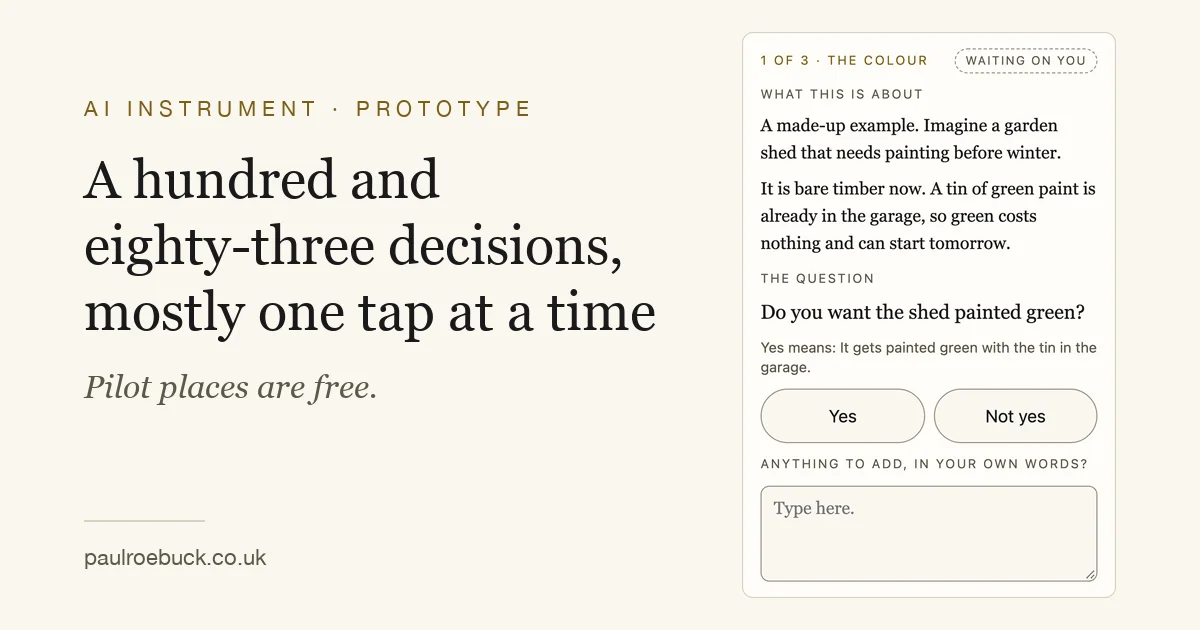
Writing a book is mostly deciding. Which story goes in, which word, what stays out. My new book, Same Is Safe, is ninety thousand words. I wrote it with AI in three and a half days, from the Saturday to the Tuesday night, and spent the Wednesday putting it right. In those five days I made a hundred and eighty-three decisions about it and the pages around it. Most were a single tap on my phone. Where the record has the clock, a card took me about a minute, often less.
That’s not because I rushed. It’s because of a page we call the yes not yes.
The problem it solves
When you work with AI, it asks you things. Lots of things. Usually it asks in the chat, a wall of questions, and you answer three, miss two and misread one. Or it asks the kind of question you can’t answer without going back to find out what it’s talking about.
I’m a psychotherapist. I know what happens when someone’s asked too much at once. They stop answering, or they answer what’s easiest, not what’s true.
What the page does
Every open decision gets a card. Each card does the same few things, in the same order.
- It tells me what it’s about first. Plain words, for someone who wasn’t in the room when the question came up. That rule came from my own frustration: on the first night I tapped “not yes” on five cards because I didn’t have the context.
- It asks one question. Asked the positive way round: “Shall this go in?”, never “Does this stay out?”
- It says what yes means. Exactly what will happen if I tap it.
- Not yes isn’t a dead end. It offers an alternative, and if I say no to that, a second one.
- There’s always a box for my own words. Even on a yes. A yes with words in the box is a yes on a condition.
- There’s a third button: Explain this more. It’s an answer, not a dodge. The card comes back with more context.
- A tap is a ruling. It’s never asked again. Answered cards drop below a line, newest first, so the page only ever shows what’s still open.
What happened with the book
The very first page went up on the Saturday night, for the people whose shoulders the book stands on. Fourteen cards; I said yes to nine of them in three minutes. The book’s own page followed an hour later with twelve cards, and by eleven o’clock every one was settled.
Over the five days the page went through thirty versions. Here’s what I decided on it:
- 163 yes
- 17 not yes, and most of those ended in one of the card’s alternatives, or in my own words
- 1 where none of the three options was right, so I gave it a steer of my own
- 2 “explain this more”
Some of the speeds still surprise me. On Wednesday evening I answered eight cards in nine minutes, then fifteen in thirteen. At three in the morning on the Wednesday I was ruling on my fact-checker’s cards, one quote and one date at a time.
That’s what made a ninety-thousand-word book in five days possible. Not the AI writing fast, though it does. The deciding getting fast. Every one of those decisions is in the book’s record, with what was done about it. Not all of them were one tap each. One yes took forty small fixes my fact-checker had found, each with its answer ready. Another settled twelve cards about my other pages at once. A few I gave by voice.
Where it went wrong
I’ll be honest, because the page is meant to be honest. On the Wednesday I got sick of it. The AI put up yet another page that evening, and I told it, in words I won’t repeat, that I’d had enough of clicking.
I’d already said go, and it was still asking. So we changed the rule. Once I’ve said “go”, the AI makes the small calls itself, marks each one so I can undo it, and only stops for the things that are truly mine: naming someone, the law, money, anything public, and what only I can tell it. The page is for real forks, not for everything.
Why it works
It works for the same reason a good therapy session does. One thing at a time. Context before the question. A way to say no that isn’t the end of the conversation. And a box for whatever you didn’t expect to say.
The decisions were always mine. The page just made them quick to make, and kept every one of them on record.
Try it
The yes not yes is a prototype, and I’m looking for a small number of people who work with an AI most days to try it on real decisions, then tell me where it helped and where a card missed the point.
Pilot places are free.
Try the example → Join the pilot →
(say “yes not yes” in your message)
How it started: the first post →
Paul Roebuck
Comments
Comments appear straight away and anyone can read them. Please don’t share anything you’d want kept private.