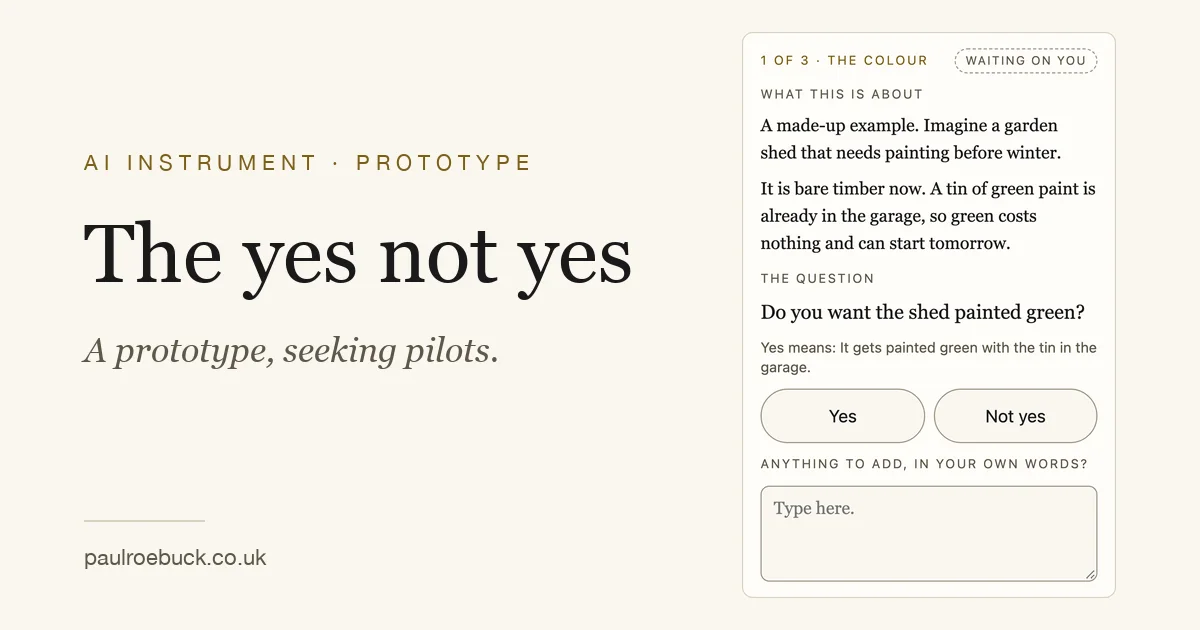
A small tool for giving an AI your decisions. It is a prototype, and I am looking for pilots.
Pilot places open
I work with AI most of the day. The slow part is not the AI. It is me, answering its questions.
It asks ten things at once. I answer three, skim four and miss the rest. Then it builds on what it thinks I said.
So I asked for one thing. Put each decision on a card, and let me tap.
What a card holds
- What this is about, in plain words, before anything is asked.
- One question, asked the positive way round.
- Two buttons: Yes, and Not yes.
- Under the question, a line that says exactly what happens if I tap Yes.
- A box for my own words, always open.
Why not yes, and not no
What is the opposite of yes?
The obvious answer is no. Mine is not yes. No is only one of the things on the other side. There is also not yet, and something else nobody has offered.
So when I tap Not yes, the card asks: if not yes, then? It offers another way, with its own Yes and Not yes. If that is not it either, it offers a second. If none of them is right, the decision stays open and nothing changes until I say.
A Yes can carry a condition, too. Yes, but only before Friday. The box is there for that.
The first run
I tried it on one of my own projects: 14 questions, 9 ruled yes, in three minutes, on my phone. Counted 21 November 2026.
The five I did not say yes to were the useful ones. Each had been asked without enough context. They were rewritten with the context first, and the tool now refuses to make a card without it.
When I am done I press one button. It copies my answers as plain text and I paste them into the chat. On the example page below, nothing is saved or sent.
It is not how an AI thinks
An AI does not choose between two things. For every next word it weighs a wide spread of them. Yes or not yes is how a person gets a straight answer out of that spread, and how a person gives one back.
It is built to work the other way round
The same page can be laid in front of a person by their AI. I am about to try that with my own AI coach: it writes the cards from what I have told it, I tap, and I paste my answers back.
A prototype, seeking pilots
This is a prototype. I am looking for a small number of people who work with an AI most days and would try it on real decisions, then tell me where it helped and where a card missed the point.
Pilot places are free.
Try the example → Join the pilot →
(say “yes not yes” in your message)
— Paul
Comments
Comments appear straight away and anyone can read them. Please don’t share anything you’d want kept private.