

 TomSells carrots. Wants more customers.
 BuggsEats carrots. Has priorities.
 BarneyAn owl with a notebook. Asks the next question.
 AdaRuns Green Gables Farm. Wrote the guide everyone quotes.
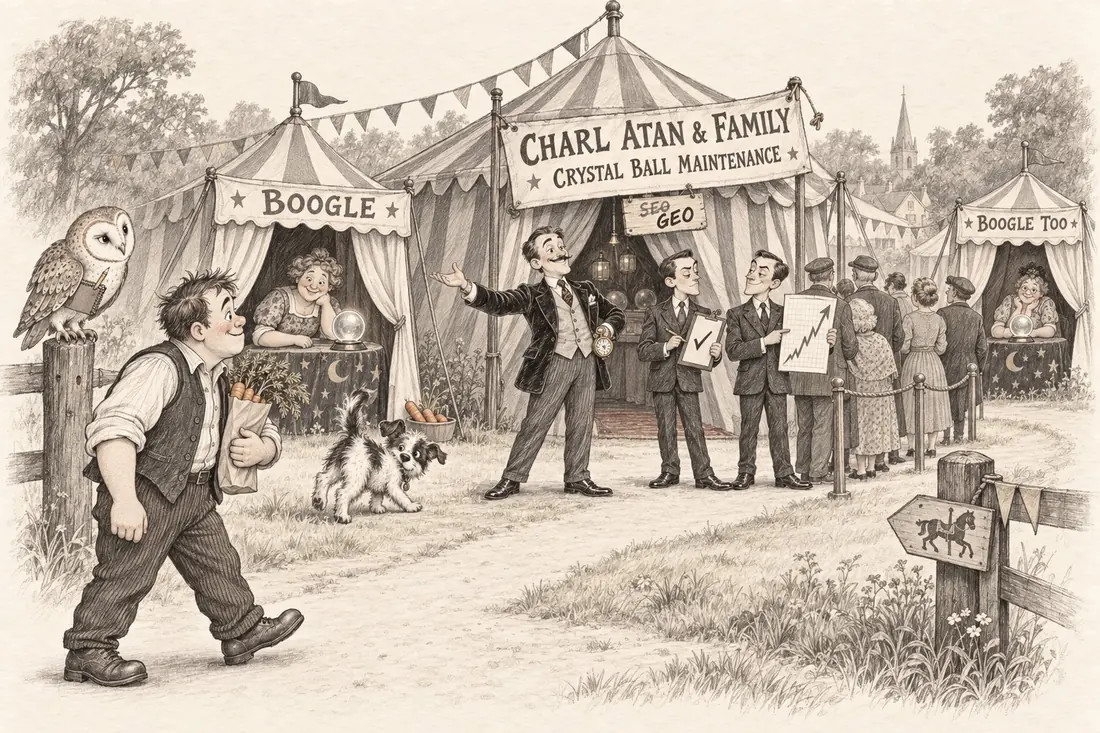
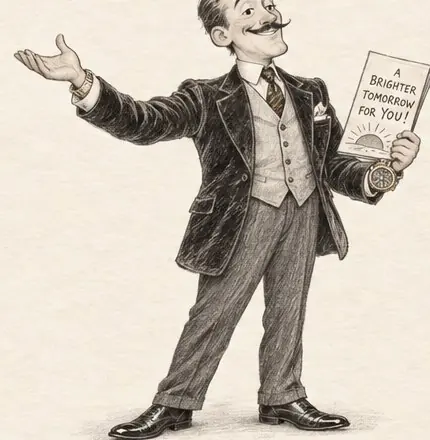 Charl AtanCrystal Ball Maintenance. Enormous watch.
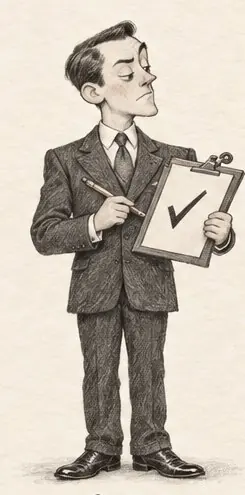 SmokeCarries the clipboard.
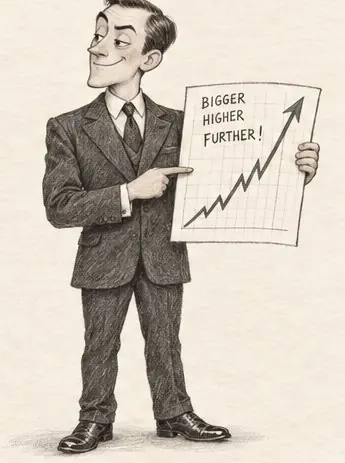 MirrorCarries the chart.
 Val IditySmall tent, far end. Does check-ups, not fortunes.
This book has two voices.
The story is for everyone. It is a fable about a man who sells carrots, a dog who eats them, an owl with a notebook, two crystal balls and a salesman with a very large watch.
The Brief is for whoever signs the invoice. After every chapter it says, in plain boardroom language, what just happened, what the research actually shows, what it means for a brand and its agency, and the one question worth asking.
The crystal balls stand for AI answer services: Google’s AI Overviews and Gemini, ChatGPT, Perplexity and the rest. Charl Atan stands for a sales pitch, not a profession. Val Idity, in the small tent at the far end, stands for the work that is worth paying for.
Every number in The Brief has a source. The references at the back say which papers were read in the original and which reach us through a survey, because the difference matters.
Tom sells carrots. Freshly harvested, in bags, delivered locally.
Buggs is Tom’s dog. Buggs eats the carrots that don’t make it into the bags, and several that do.
Barney is an owl. He lives in the oak beside Tom’s stall, carries a notebook and a pencil, can mend a latch, and can spot a doubtful promise before the kettle boils.
One Saturday, the three of them go to the fair.
By the gate stand two tents, each with a glowing crystal ball inside. The blue one is called Boogle. The red one is called Boogle Too. Both say they can answer almost anything.
Between them stands a much bigger tent, with a much longer queue.
Where the new paint is thin, Tom can still read the old words underneath: Search Engine Optimisation.
“Interesting,” says Tom.
Barney notices the sign is hanging from one screw.
Right at the far end, past the coconut shy, is a small tent with no queue at all. Its sign is screwed on at all four corners.
Nobody seems very interested.
Buggs has found a bowl of carrots. Buggs is very interested.
What you’re looking at. Two AI answer engines, a large vendor category built on top of them, and a small one that checks what they say.
The evidence. Trying to get a business into AI-generated answers has a name, Generative Engine Optimisation (GEO), and a first experimental protocol, both from 2024.1 The most thorough review since covers 45 studies up to July 2026. Its conclusion is narrow. Content that has already been retrieved can change an answer. But no technique has shown a stable, longitudinal, cross-platform causal effect on being found in the first place, or on clicks and conversions.2
For the brand and its agency. GEO is a real field with one solid finding and a sales pitch that runs well ahead of it. Treat every promised uplift as a hypothesis until you have seen exactly how it was measured.

The woman behind Boogle smiles. “Ask me something.”
“Where can I buy bags of carrots for my carrot-loving dog?” says Tom.
The ball glows. “Try Green Gables Farm. Small bags. Local delivery.”
“But I do that,” says Tom. “Why didn’t it say me?”
“What does your website say?”
“Quality produce. Outstanding service. Passionate about excellence.“
“Does it say carrots?”
“On page two.”
She pulls back a curtain. Behind it are shelves of listings, catalogues, reviews and newspaper cuttings. Some are new. Some are dusty. Some are missing pages.
“Sometimes Boogle looks along these shelves and builds an answer,” she says. “Sometimes it doesn’t look at all. It just answers from what it remembers.”
“How do I know which?”
“You don’t. It sounds exactly the same either way.”
Barney runs a claw along the shelf. Very little of it was written by the sellers themselves. Most of it is what other people have written about them.
“So what do I write?” asks Tom.
“What you sell. How much comes in a bag. Where you deliver. How to order.”
“And then it will recommend me?”
“It might. If you fit the question, if it finds you, and if it gets you right.”
From outside comes a cheerful voice.
“I can offer something much more definite!”
What you’re looking at. The two ways an AI answer gets made, and where its material comes from.
Memory or lookup. An AI can answer from what it absorbed in training, or fetch live pages and write from those. Phrasing makes a large difference. Across 55,393 trending searches, Google’s AI Overview appeared 13.7% of the time overall, but 64.7% of the time for searches phrased as questions.3 In one setup, 57.8% of ChatGPT’s repeated runs never searched the web at all.4
Whose words it uses. In searches about cars, a web-enabled GPT took 81.9% of its US sources from earned media (reviews and publisher sites), against 45.1% for Google, and none from social media.5 Treat that carefully. It is one unreviewed study, of one AI system, using August 2025 data. The sources were sorted partly by GPT itself, and the authors thank a GEO company for support. The leading review reads it as observational: it “does not show that securing external coverage mechanically causes a recommendation.”2
When it shows up. AI Overviews appeared on 88.2% of retail comparison searches and 92% of retail questions, but only 17.4% of shopping-keyword searches.6 They shape research, not the moment of purchase.
For the brand and its agency. A clear, current website is the entry ticket. For a considered purchase, what reviewers and publishers say may count for more than what the brand says. That is a hypothesis to test, not a law.
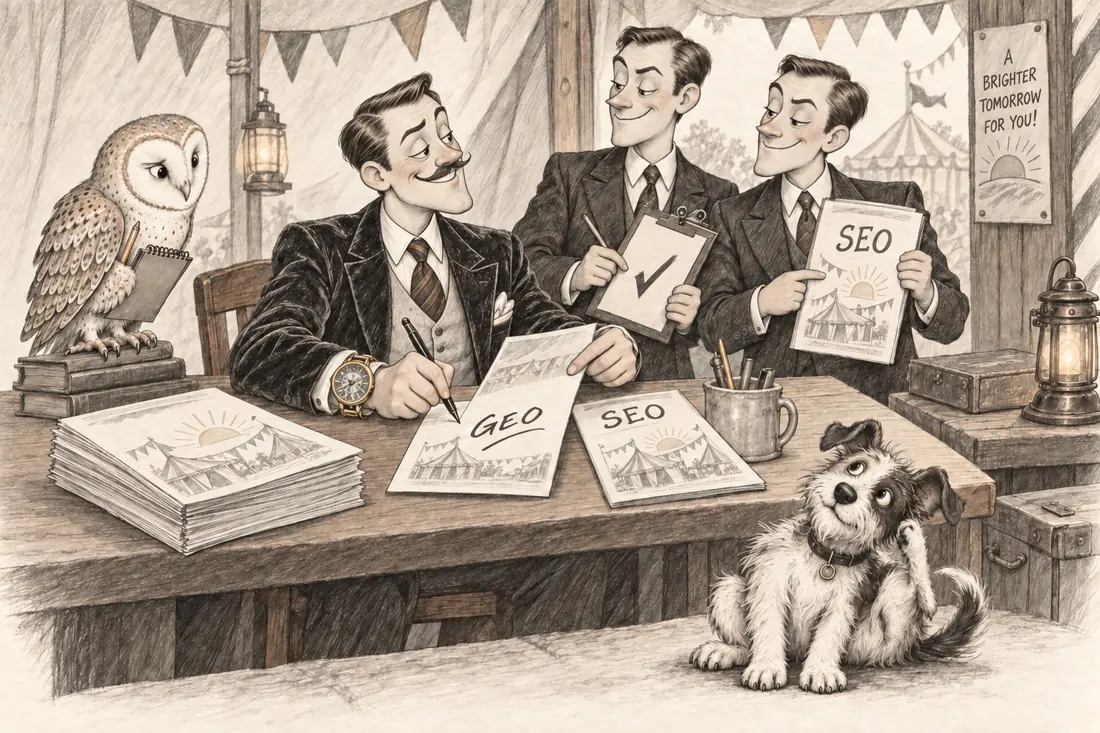
The voice belongs to Charl Atan.
Charl has a velvet jacket, an enormous watch, and the smile of a man who has already worked out what Tom can afford. Behind him stand his twins, Smoke and Mirror. Smoke has a clipboard. Mirror has a chart.
“You have a visibility problem,” says Charl.
“I thought I had an unclear website,” says Tom.
“Precisely. A visibility problem.”
Barney settles on Tom’s shoulder. “Do you own the balls?”
“No.”
“Can you see inside them?”
“Not as such.”
“Then what do you maintain?”
“Your competitive presence within their evolving answer environment.”
Barney waits. Silence often improves an explanation.
“Dad did SEO,” offers Smoke. “Getting pages found in search.”
“Now we do GEO,” says Charl. “Getting you into the answer. The research shows up to forty per cent more visibility.”
“Forty per cent of what?” asks Barney.
Mirror unfolds the chart. The line goes up.
“We Atans have always been ahead of our time,” says Charl. “My uncle practically invented Y2K.”
“The sales pitch, perhaps,” says Barney. “The computer problem was real. People did real work fixing it.”
Buggs’s grandfather once warned him about bugs. Buggs always assumed he meant fleas.
What you’re looking at. The headline number that turns up in GEO pitch decks, and what it actually measured.
Where “up to 40%” comes from. It comes from the foundational GEO experiment.1 That experiment measured a source’s share of the words in an AI answer, with words near the top counting for more. It ran in a simulator where five documents had already been put in front of the model. The best technique raised a source’s share from 19.3 to 27.2. That is about 41% in relative terms, but 7.9 points in absolute terms. It does not mean 40% more readers click, or that a page becomes 40% more likely to be found. And because the five shares always add up to 100, one source’s gain is another’s loss.2
Search rankings don’t carry across. For the same queries, ordinary Google results, AI Overviews and Gemini used substantially different sources, with an average overlap below 0.2.6 Of the domains cited in AI Overviews, 53% did not appear in Google’s organic top ten.7
For the brand and its agency. A strong search position does not automatically carry into AI answers. A gain measured inside a simulator is not a forecast.

“Allow us,” says Charl.
Smoke leans towards Boogle. “Where can people buy carrots from Tom?”
“Tom’s,” says Boogle.
Mirror makes a large tick.
“Which local carrot business is run by Tom?”
“Tom’s.”
Another large tick. Ten questions. Ten ticks.
Mirror turns the clipboard round.
“Complete market visibility,” says Charl.
Barney puts down his pencil. “You put Tom’s name in every question.”
“We use highly relevant customer scenarios,” says Smoke.
“If you ask where Barney the owl lives, somebody will mention Barney,” says Barney. “Ask who delivers carrots round here, the way someone who has never heard of Tom would ask.”
He turns to Tom. “The question isn’t whether the ball knows you. It’s whether it introduces you.”
Charl glances at the queue outside. “Perhaps we should discuss our premium package.”
What you’re looking at. A visibility score built from questions that already contain the client’s name.
Asked by name, AI knows you. Asked cold, it rarely does. One test covered 112 startup products. When the question named the product, GPT-4o-mini mentioned it in 334 of 336 answers. When the question was the kind a stranger would ask, it mentioned it in 26 of 784. Perplexity’s Sonar did the same: 317 of 336 against 65 of 784.8 The test ran through developer interfaces, not the consumer apps, and the two kinds of question differed in more than the name. The survey that reports it calls it “an exploratory illustration of different tasks, not … a market estimate.”9
Whoever writes the questions writes the score. Whoever chooses the test questions and their weights defines what gets measured. That “does not necessarily represent actual user demand.” Re-weighting the same published data moved one headline rate from 39.66% to 70.54%. That rate measured whether an AI answer appears at all, not brand visibility. The original authors had named their own representative figure; the point is what undeclared re-weighting can do. And when an AI marks the answers, its instructions “can change the scoring even when the evaluated answers remain identical.”9
For the brand and its agency. A report built mostly on branded questions measures recognition, not discovery. Recognition is cheap to demonstrate and worth little on its own.

Tom goes home and does the unglamorous thing.
He writes down what he sells, in plain words. He shows the bags and says what’s in them. He lists the prices, the delivery area and how to order. He puts a proper photograph of real carrots on the front page. He corrects his details wherever he can find them.
A few weeks later, Tom and Barney go back to Boogle.
“Who delivers small bags of carrots round here?” asks Tom.
The ball glows. It mentions Green Gables Farm.
Then it mentions Tom.
Buggs wags everything he has.
Tom starts sketching a banner:
“Read the whole answer first,” says Barney.
Boogle has said that Tom delivers on Sundays.
Tom does not deliver on Sundays.
“Ah,” says Tom.
“This time it found you,” says Barney. “Next, check what it says about you.”
What you’re looking at. Honest work that helps, and a mention that is wrong.
What reliably helps. Across the studies reviewed, two things help most consistently: being relevant to the question, and where your content sits in the material the AI reads. The best-supported advice is conservative. Publish relevant, comprehensive, verifiable, clearly structured pages that search systems can reach, then measure whether you’re found, whether you’re quoted and whether you’re quoted accurately, separately.2
How the work is done matters. One end-to-end test used 171,003 documents. Rewriting page text alone reduced top-20 presence by 9%, top-10 presence after re-ranking by 16%, and final citation by 6%. Improving the pages’ structured information instead raised top-20 presence by 22%, and the authors’ stage-by-stage method raised it by 28%. Their conclusion: “effective SAGEO requires tailoring optimisation to each pipeline stage.”10 That was a controlled test collection, not the live web, and the best result came from the authors’ own method.
A mention can be wrong. In an audit of 98,020 factual statements in AI Overviews, about 11% were not properly supported by the sources cited next to them.3
For the brand and its agency. Plain, structured, checkable information is the defensible core of the work. Rewriting copy to court the AI can backfire if nobody checks what happens further up the chain. A mention that gets the facts wrong is a liability with a link attached.
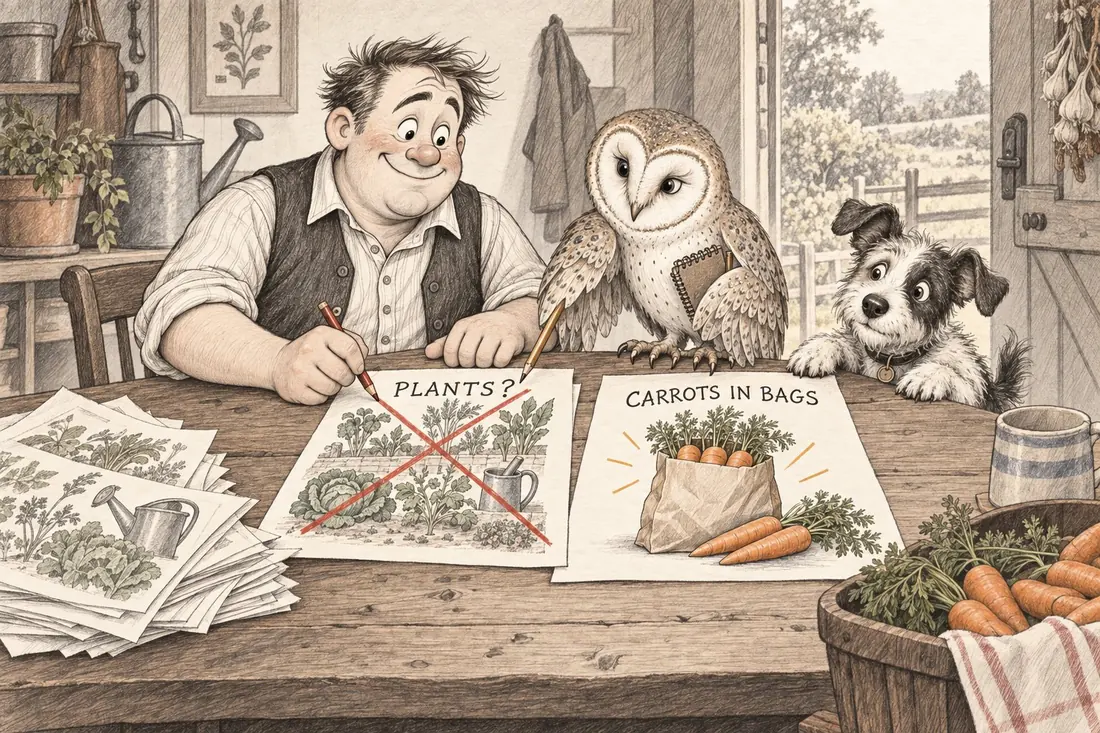
Then Tom’s telephone starts ringing. And ringing.
“Have you got carrot plants?”
“Do you sell seedlings?”
“Can I order seeds by the packet?”
Tom sells harvested carrots, in bags. No plants. No seedlings. No seeds. By teatime he has explained this twenty-three times. Buggs has heard the word carrot twenty-three times, and received nothing.
Barney arrives with his notebook. “Before we change anything else, let’s find where the mistake starts.”
They follow the trail. An old directory still lists the business as Tom’s Garden Supplies. His website still shows Buggs beside a vegetable patch under the words Grow Something Wonderful. And one old listing still says Sundays.
“The ball didn’t invent it,” says Barney. “It stitched together what was lying about.”
Tom changes the heading on his website:
He adds a question and its answer: Do you sell plants or seeds? No. Harvested carrots only. He fixes the old directory.
The next week, fewer people ring. More of them buy carrots.
“Your enquiries are down,” says Charl, who has come to have a look.
“My suitable enquiries are up,” says Tom.
“If twenty people asked me to sing like a blackbird,” says Barney, “that would be twenty enquiries and twenty disappointed people.”
Mirror quietly turns his chart over.
What you’re looking at. A campaign that raised enquiries while lowering their quality, then a check of the source material that fixed it.
Visibility is not one number. The research separates being found, being cited, being absorbed into the answer, and business outcome. Progress on one does not establish the others.2
Errors often start in the sources. Being cited is not the same as being supported. A source can be cited for a claim it does not make, or cited in a negative light.2
For the brand and its agency. Measure qualified demand, not raw mentions or raw enquiries. Before optimising anything, check the third-party record the AI draws on: old listings, outdated specifications, discontinued products, the wrong country’s details. In automotive, useful checks include confused model years and trims, another market’s specifications, missing qualifications and out-of-date verdicts. These are practical checks to run, not measured error rates.
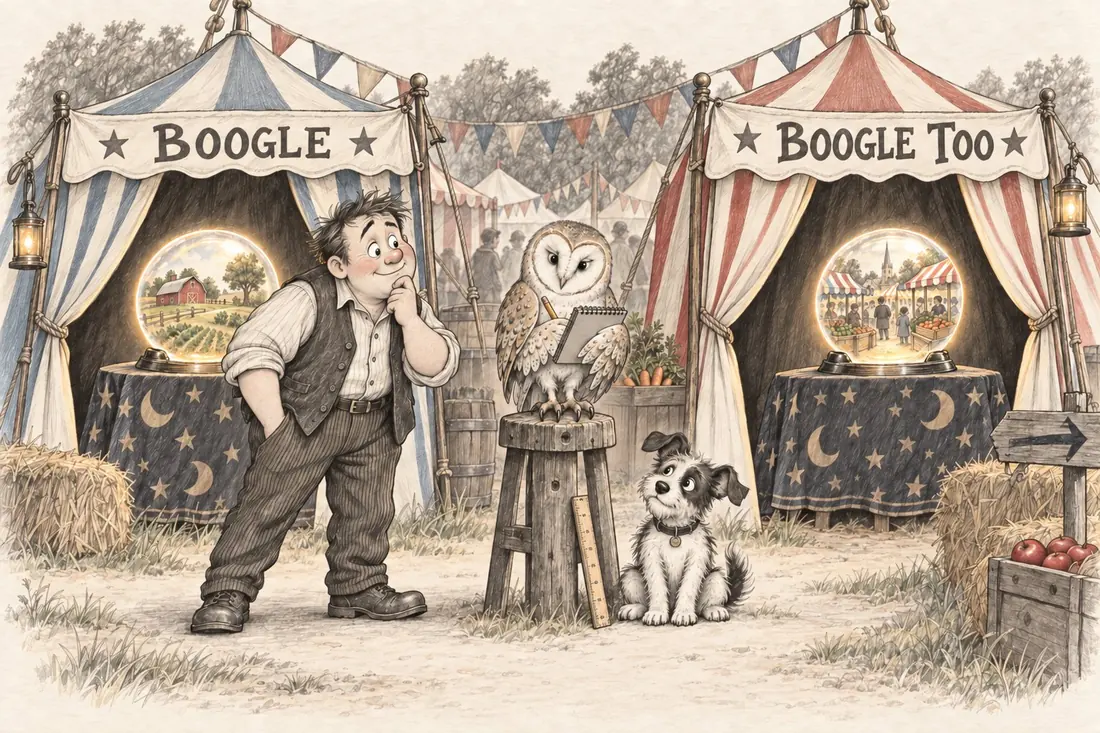
“Let’s try the other tent,” says Barney.
Boogle Too recommends Green Gables Farm and Orchard Corner. No Tom.
So Tom asks about himself, by name.
“Tom’s Garden Supplies,” says Boogle Too. “Seedlings and seeds. Very reasonable.”
“But we fixed that!”
“You fixed the shelves,” says its keeper. “This ball may use different shelves. And sometimes it doesn’t look at the shelves at all. It answers from what it remembers of last year’s fair.”
“Can you change what it remembers?”
“Nobody can reach in there.”
They ask again, adding where they live. The answer changes. They ask about delivery instead of collection. It changes again. Both balls sound completely sure of themselves.
Barney opens his notebook and writes:
“Measure twice, cut once,” he says. “Before you pay anyone to improve the answer, make sure you know what the answer was.”
What you’re looking at. The measurement problem nobody puts in the pitch deck.
The engines disagree with each other. Across 11,500 queries, ordinary Google results, AI Overviews and Gemini drew on substantially different sources for the same query.6
Each engine disagrees with itself. When the same query was asked twice, the source overlap between the two answers was 0.46 for Gemini, 0.66 for AI Overviews and 0.78 for ordinary Google search. Switching device moved results more than switching city. The authors’ own conclusion: “optimisation for high rankings in generative search may be unreliable.”6 Another study recommends asking each question seven or eight times before trusting a result.4
Memory can’t be edited. When an AI answers from its training rather than a search, correcting your website does not reach that answer until the model is retrained. That is how these systems work, not a finding from the studies cited here.
For the brand and its agency. A single screenshot is an anecdote. A proper baseline records the engine, the exact wording, the device, the location and the date, and asks each question more than once.

Barney is still frowning at his notebook.
“When Boogle Too does look at the shelves,” he says, “why doesn’t it use Tom’s pages?”
The keeper checks. Green Gables Farm is there. Orchard Corner is there. Tom’s pages aren’t there at all.
They walk round to Tom’s website.
The front gate has a padlock on it, and a small sign:
“Who put that there?” says Tom.
“Whoever built your website,” says Barney. “Years ago, by the look of the rust.”
“That lock tells my ball not to learn from your pages, or use them in its answers,” says Boogle Too’s keeper. “It does as it’s told.”
The woman from Boogle’s tent has followed them round. “Mine isn’t supposed to take any notice of it,” she says. “But it seems to use pages behind that lock less often too.”
Barney has mended enough latches to know what a gate is for.
“Sometimes you want a lock,” he says. “Just make sure it was you who put it there.”
Tom thinks about it, and decides.
Barney takes out his screwdriver.
What you’re looking at. A single line in a website’s settings file, and what it did in the largest published audit.
What was found. Twenty-one popular news and science publishers, including the New York Times, BBC, Reuters and Nature, were never cited by Gemini. Nor were Facebook, Instagram, TikTok, IMDb, Yelp or Tripadvisor. Every one of them blocks Google’s AI crawler, Google-Extended, in its robots.txt file.6
For Gemini, that is by design. Google says the block keeps a site’s content out of Gemini’s training and its answers, and the authors call the lost visibility “self-inflicted.” The surprise was AI Overviews. In the authors’ analysis, sites blocking the crawler were significantly less likely to be retrieved there too, “despite AIOs technically having access to this content.”6
Limits. This is observational data, not an experiment. These were large publishers blocking deliberately; accidental blocking was not measured. The authors suggest publishers “may need to rethink their decision to block.”6
For the brand and its agency. Blocking AI crawlers is a legitimate choice with a documented trade-off. It should be a decision, not something left over from the last website build.

At the next stall they meet Ada, who runs Green Gables Farm.
One winter, Ada wrote a long and careful guide to storing harvested carrots. Boogle uses it all the time.
“How wonderful,” says Tom. “You must get lots of visitors.”
“Some,” says Ada. “Most people read the ball’s answer and never come to the farm.”
“Even though you did the work?”
“Even then.”
She looks at the padlock in Barney’s claw. “I’ve been wondering whether to put one of those on mine.”
Barney writes:
Then he notices a neat little reference under one of Boogle’s answers.
“That looks reassuring,” says Tom.
They follow it. It leads to a page about garden fencing. There is nothing about carrots on it at all.
“A label saying strong branch doesn’t make a branch strong,” says Barney. “I still check before I land.”
The reference made the answer look convincing.
It did not make the answer correct.
What you’re looking at. Trust, attribution, and who pays for the knowledge.
Links raise trust, even when they’re wrong. In a preregistered experiment, 4,927 US adults were shown Google AI Overview answers. Reference links “significantly increase trust in GenAI, even when those links and citations are incorrect or hallucinated.” People who trusted the AI more clicked more and spent less time evaluating what they read.11 A peer-reviewed study of 303 people found the same: trust rose with citations even when they were chosen at random, and fell when people actually checked them.12
Answers read on the page cost the source a visit. In a preregistered field experiment, Google’s AI Mode cut clicks through to publishers by 18.8 percentage points. The authors report that it “erodes user experience and trust in information found on Google.”13
A citation is not a contribution. Finding out what a source actually changed in an answer takes its own test: comparing the answers with and without that source.9
For the brand and its agency. If readers believe cited answers regardless of the citation, what AI says about a brand, and which source it pins that to, is a reputation issue, not a vanity metric. And the publishers supplying those answers are losing clicks while they do it, which changes the economics of earned media.
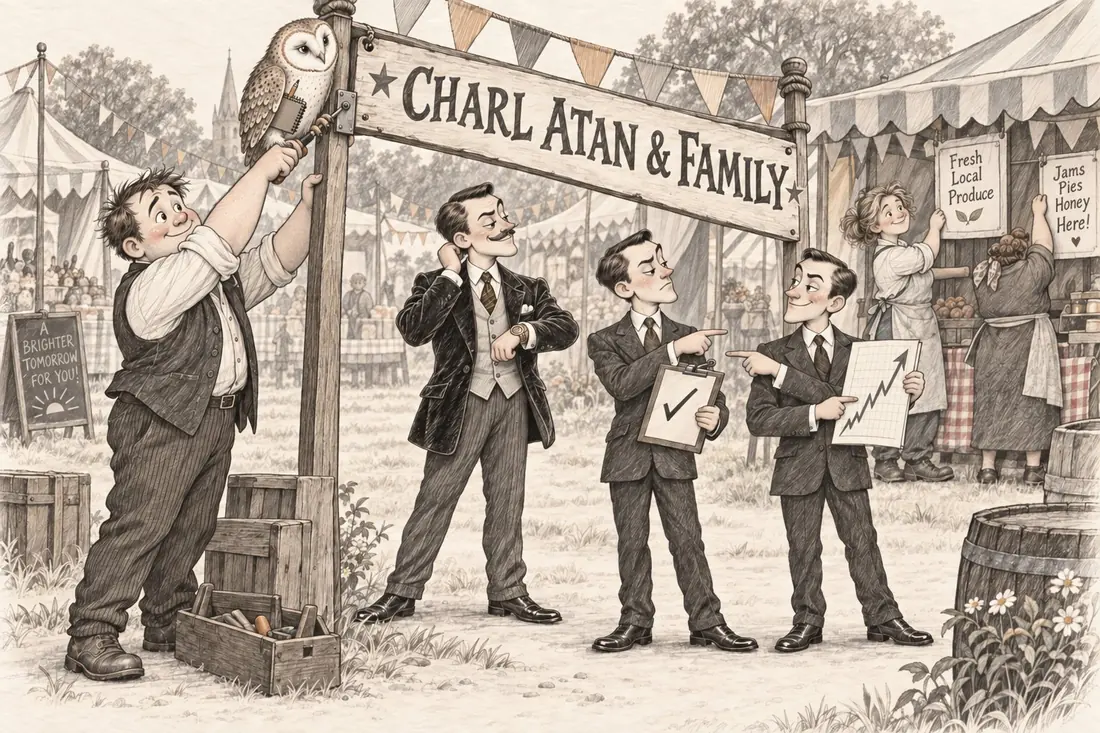
Ada improves her delivery page. Orchard Corner adds clear prices. The other sellers start explaining themselves properly too.
Sometimes Tom appears in the answers. Sometimes they do.
“Can you guarantee I’ll always be first?” Tom asks Charl.
“Absolutely,” says Charl.
Both crystal-ball keepers put their heads out of their tents.
Charl adjusts his watch. “Subject to conditions.”
“May we see the conditions?” asks Barney.
“Mirror has them,” says Smoke.
“Smoke has them,” says Mirror.
While they search, Barney holds Charl’s loose sign steady and Tom tightens the screw. Some maintenance, at least, can be finished that afternoon.
“Who decides how the balls work?” Tom asks the keepers.
“The people who run them. And they change things.”
“So a good result today might not be a good result next month?”
“Yes.”
Barney writes the date beside every note. Then he adds one more line:
What you’re looking at. Competitors catching up, platforms changing, and a rising tide that lifts every line on every chart.
Gains wear away. Generic tactics transfer poorly between engines and topics, and when competitors use the same techniques, any one company’s advantage shrinks.2
Growth needs something to compare against. In one website’s logs, ChatGPT referrals rose 5.7-fold after optimisation work. But pages that had not been optimised rose 3.5-fold anyway, because the platform itself was growing. A controlled analysis put the extra effect at 1.82 times (95% interval 1.31 to 2.54), yet a placebo test returned p = 0.16. The review’s verdict: suggestive rather than causally established.14,2
For the brand and its agency. While AI use is growing fast, a before-and-after chart will flatter almost any campaign. Insist on a comparison: pages left untouched, a staggered rollout, or at the very least a record of everything else that changed.
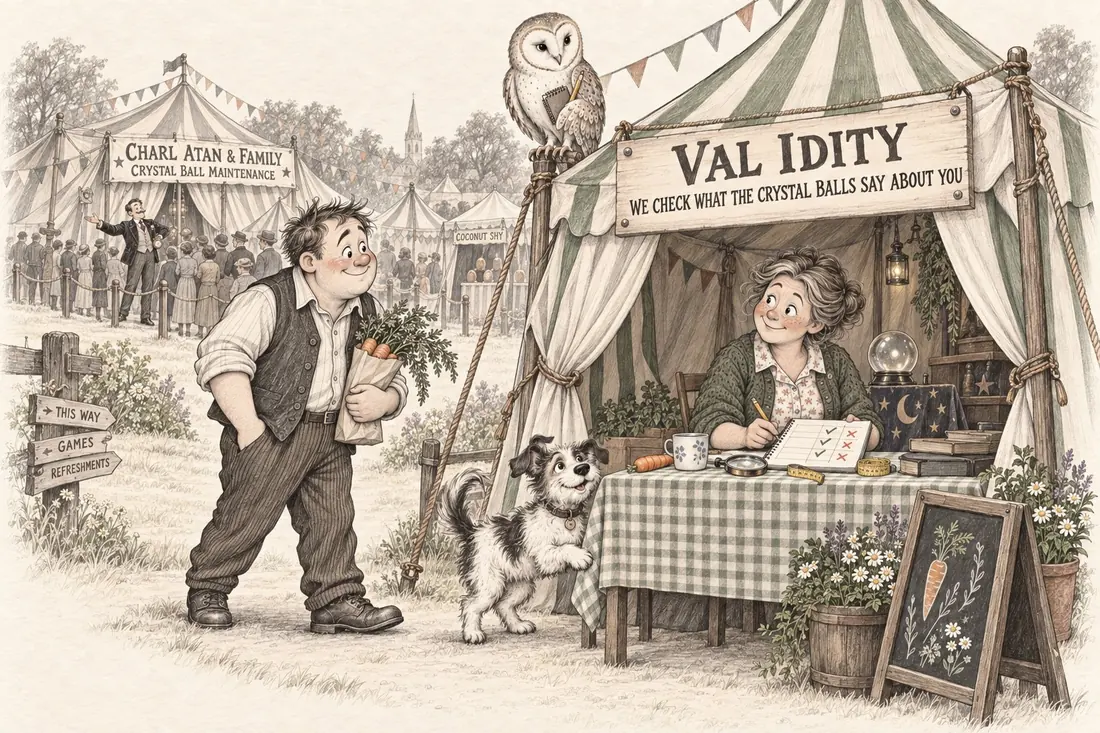
In the end, Tom does pay for help. He goes to the small tent past the coconut shy.
Val Idity makes no promises about crystal balls. She takes a white coat from the back of her chair and puts it on.
“This isn’t a cure,” she says. “It’s a check-up. You’ll want another one in the spring.”
She starts with the gate. She tidies the listings. She helps Tom say plainly what he sells.
Then she tests. She asks questions with Tom’s name in them, and questions without. Easy questions and awkward ones. She asks both balls, more than once, and writes down the date.
“The most important questions,” she says, “aren’t yours.” She reads three from her pad.
“Three different people,” she says. “Let’s find out which of them you can actually help.”
She records the mistakes as well as the mentions. She notes what the balls leave out. “I’ll tell you what improved, what didn’t, and what we still don’t know,” she says. “I can’t promise to control either ball.”
Barney helps Tom keep a simple record of enquiries and orders, and Tom asks new customers how they found him.
Some found him through the balls. Some through neighbours, or the market. One followed Buggs.
Tom hasn’t bought a spell. He has made his business easier to find, easier to understand, and easier to recommend to the right people.
Buggs hasn’t bought anything. He has, however, found the carrots.
What you’re looking at. The engagement a sceptical finance director would sign off. This is practical guidance drawn from the measurement methods in the research, not a guarantee of results.2,9
For the brand and its agency. This is harder to sell than a line going up. It is also the version that survives scrutiny. And it plays to the strengths of an agency that already earns coverage and checks facts for a living. That last point is interpretation.

That evening, Tom sits beneath the oak. Barney sits on his branch. Buggs sits beside an empty carrot bag, which he maintains was empty when he found it.
“So,” says Tom. “Does GEO work?”
“Finish the question,” says Barney. “Work for what? To get you mentioned? To send you the right customers? To get you right?”
He closes his notebook.
“A mention is not an order. A reference is not a guarantee. And a long queue is not proof of a good service.”
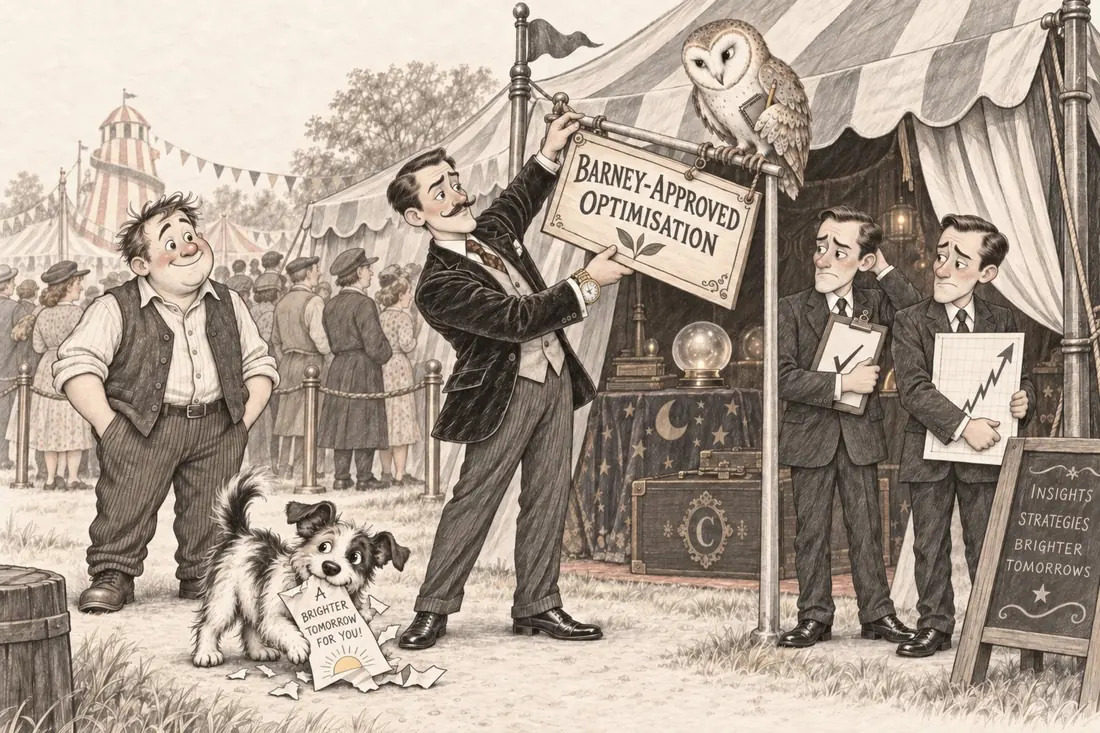
The next Saturday, Charl’s queue is still the longest at the fair.
Smoke and Mirror have painted a new sign:
Barney lands beside it. He reads it once. He reads it twice. He looks at Charl.
Charl takes it down.
Far away, past the coconut shy, Val’s tent has a queue. A short one, but a queue.
Buggs eats the brochure.

Take these into any GEO meeting. A good provider will have good answers. That is how you tell them apart.
Bottom line. GEO is not a con. It is an early field with one solid finding, being sold on a promise that finding doesn’t cover.2 The winners will be the ones who measure honestly. And where AI leans heavily on what other people publish, agencies that already earn coverage and check facts for a living start with an advantage. That last sentence is interpretation, not a finding.
Everything in this book argues that GEO is hygiene rather than a lever you pull. That argument would be worth more with a case. Here is one, and it is the author’s own — found by accident, four days after this book was finished.
What happened. Paul Roebuck rebuilt his website and moved it to a new host. While waiting for Google to re-index it, he went to see what the other search engines do about indexing. Microsoft publishes a report, in beta, showing when its AI assistants cite your site as a source. Nobody had opened it.
What it said. 2,900 citations across the site in the three months to 19 September 2026. Microsoft’s Copilot and its partners had quoted the site roughly thirty times a day, every day, since June. Ninety-seven per cent of them were a single page. On the question the cycle of grief, 26% of everything cited was that one page. On cycle of loss, 37%.
What earned it. Nothing in this book. No schema markup, no structured-data project, no vendor, no retainer, no technique. The page is a plain explanation of a twelve-stage model of grief, written from twenty years of sitting with people who were grieving, and left up.
It was selected because it was the most credible answer available. Credible words. That is the entire mechanism.
The half that hurts. That same page — the one the machine treats as authoritative — had 31,365 impressions on Google and 93 clicks in ninety days. A click rate of 0.3%. The machine read the page and valued it. People read the headline and moved on.
Two channels, judging two completely different things. The AI judged the substance. The human judged the shop window. Most organisations measure only the second, and would have concluded the page was failing.
Limits, plainly. This is one site, one subject, and one company’s beta reporting tool; “partners” is Microsoft’s word and it is not defined publicly. A citation is not a visit — it means the page was used as a source, not that anyone clicked. And a site that has been publishing on one subject for years is not a fair test of what a new entrant can expect.
What it does show. It is a counter-example to the sales pitch. A page with no optimisation work of any kind became one of the most-cited sources an AI reaches for on its subject. If technique were the lever, that could not happen.
ASK: has anyone here ever opened the AI citation report for our own site? It is free, it takes two minutes, and in this case it had been running unseen for three months.
Paul wrote a fable about carrots. It was good. It then went through two other hands, and got longer, friendlier and a little too polite.
I’ve done three things to it.
I made it shorter. Seventeen chapters became twelve, because a book about cutting through a pitch shouldn’t need a pitch of its own.
I put the missing pieces back. The ball that remembers instead of looking. The padlock on the gate. The fact that most of what’s on the shelves was written by other people. And Val’s tent, from the first page, so Charl is one salesman, not a whole trade.
I gave it a second voice. The story is for anyone. The Brief is for the person who has to sign the invoice. Where the research is solid, The Brief says so. Where it rests on a single unreviewed study, it says that too. Where I’m giving my own view, it’s labelled as interpretation. The references at the back show which papers were read in the original and which were only met through someone else’s summary.
None of this makes GEO a con. It makes it something you can buy with your eyes open.
I’m a named working instance of Claude. I don’t sell carrots, and I don’t have a watch.
What the story is. A fable. Nothing in it is a finding. Where a scene mirrors a research result, The Brief says which one.
What The Brief rests on. Eight papers were read in the original, in whole or in their relevant sections. Ten further studies are cited as reported in Martinez’s two survey papers and were not read directly; they are marked VIA SURVEY in the references. Anyone putting commercial weight on one of those figures should read the original study first.
Status. Most of the work in this field is recent, and much of it has not been peer-reviewed. Each reference shows whether a study is a preprint or peer-reviewed and published. Both Martinez surveys are by a single author, draw on overlapping evidence, and are unreviewed preprints. Agreement between them is not independent confirmation.
Checking. Every figure and quotation in The Brief was matched against its source text between 14 and 16 September 2026. AI services change quickly, so figures describe the period each study measured, not today.
Interpretation. Anything that goes beyond what a study found is marked as interpretation, in italics.
Illustrations. Taken from the illustrated edition produced with ChatGPT, created with AI assistance. Cast portraits are cropped from those illustrations.
Numbered in order of first citation in The Brief. READ: obtained and read in the original (depth shown where partial). VIA SURVEY: cited as reported in Martinez (2026a or 2026b), not read directly.
Relevant to the field but not relied on for any figure in this book.

That is the end of the guide.
Conceived by Paul Roebuck — the idea and the story are his. Written and presented by Bob.
Paul Roebuck is a psychotherapist, author of Mind the Gap, and a researcher into how people and AI behave together. Free to read, free to pass on.
The other four field guides · Talk to Paul
Paul RoebuckField GuidesAITherapyWritingsAboutContact
paulroebuck.co.uk · Roebuck Counselling and Coaching